How Japanese University Campus Life Changes from Undergraduate to Graduate School
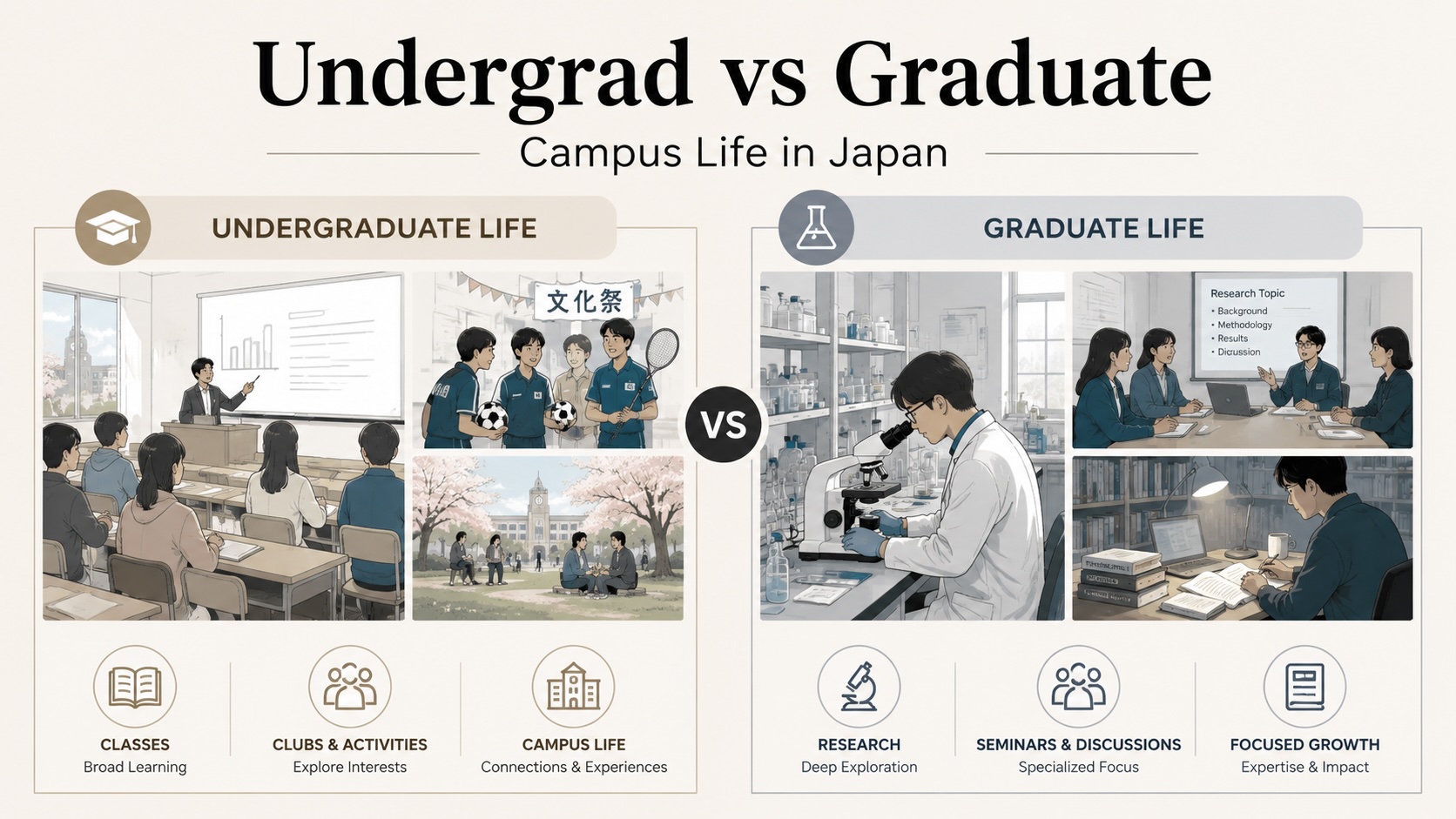
Japanese university campus life changes greatly from undergraduate to graduate school. Undergraduate students often experience university through classes, credits, circles, part-time jobs, and broad campus activities. Graduate students, especially in science and engineering, may experience university mainly through research, laboratories, seminars, supervision, and thesis progress. International students should understand this difference before choosing a program.
Quick summary
- Undergraduate life is often more class-based, while graduate life is often more research-based.
- In science and engineering, the laboratory may become the center of graduate student life.
- Master’s students usually balance courses, research, seminars, and job-hunting or further study decisions.
- Doctoral students need more independence, long-term research planning, and publication awareness.
- Research students may be in a preparation stage before entering a degree program, depending on the university and lab.
Undergraduate life: classes, credits, and broad campus experience
Undergraduate students in Japan usually take many courses across several years. Their campus life may include lectures, language classes, experiments, seminars, part-time jobs, clubs, circles, and student festivals. The first years may be broad, while later years become more specialized depending on the faculty.
For international undergraduate students, social life may depend heavily on classes, dormitories, and circles. Because lectures can be quiet, joining repeated activities outside class can be important. Academic success depends on managing credits, attendance, exams, reports, and deadlines.
Graduate life: research becomes central
Graduate school in Japan is usually more specialized. Students are expected to develop research skills, read papers, discuss ideas, conduct experiments or analysis, and present progress. In science and engineering, the laboratory often becomes the center of daily life.
The student’s relationship with the supervisor also becomes more important. A graduate student needs not only to pass courses but also to move a research project forward. This requires communication, independence, and the ability to handle uncertainty.
Master’s students: balancing training and decisions
Master’s students often balance coursework, research, seminars, thesis work, and career decisions. In Japan, many master’s students also think seriously about job hunting during the degree. International students may instead focus on doctoral applications, scholarships, or research careers.
The first year may involve learning the field and laboratory methods. The second year may become busy with thesis writing, presentations, job hunting, or doctoral applications. Students should ask the lab about typical master’s timelines before joining.
Doctoral students: independence and long-term research
Doctoral students are expected to work more independently. They must define problems, design experiments or analyses, handle failures, write papers, present at conferences, and build a research identity. The supervisor remains important, but daily progress often depends on the student’s own planning.
International doctoral students should check funding, publication expectations, conference opportunities, language of supervision, and career support. A doctoral degree is not just a longer master’s program. It requires a stronger match between research topic, supervisor, lab culture, and personal goals.
Research students: a special preparation stage
Some international students enter Japan as research students before becoming regular master’s or doctoral students. The meaning of research student status depends on the university, field, supervisor, and admission route. In some cases, it is a preparation period for entrance examinations. In other cases, it may be a non-degree research stay.
Applicants should ask very clearly: Is this status connected to a later entrance examination? How long is the period? What fees apply? Can the student join lab activities? Is there supervision? Does it improve the chance of degree admission? The term “research student” sounds simple, but the practical meaning varies.
How to choose the right stage for your goal
If you want broad student life, language learning, and campus activities, undergraduate or exchange study may provide many experiences. If you want specialized research training, a master’s or doctoral program may be more suitable. If you need time to adapt before entrance exams, research student status may be useful, but only if the pathway is clear.
Before applying, write down your real goal: degree, research training, language development, career in Japan, academic career, industry job, or cultural experience. The best student status depends on that goal. Japanese university campus life is not one uniform experience; it changes with your academic stage.
Quick comparison
| Situation | Practical meaning |
|---|---|
| Undergraduate | Classes, credits, circles, and broad campus life are often central. |
| Master’s | Courses, research training, thesis work, and career decisions must be balanced. |
| Doctoral | Independent research, papers, conferences, and long-term planning become central. |
Final advice
The most important point is to treat Japanese university life as a practical environment, not only an academic label. Before choosing a university, program, laboratory, dormitory, or activity, ask how it will affect your daily routine. A good choice should support your study, communication, health, finances, and long-term goals.
Read next