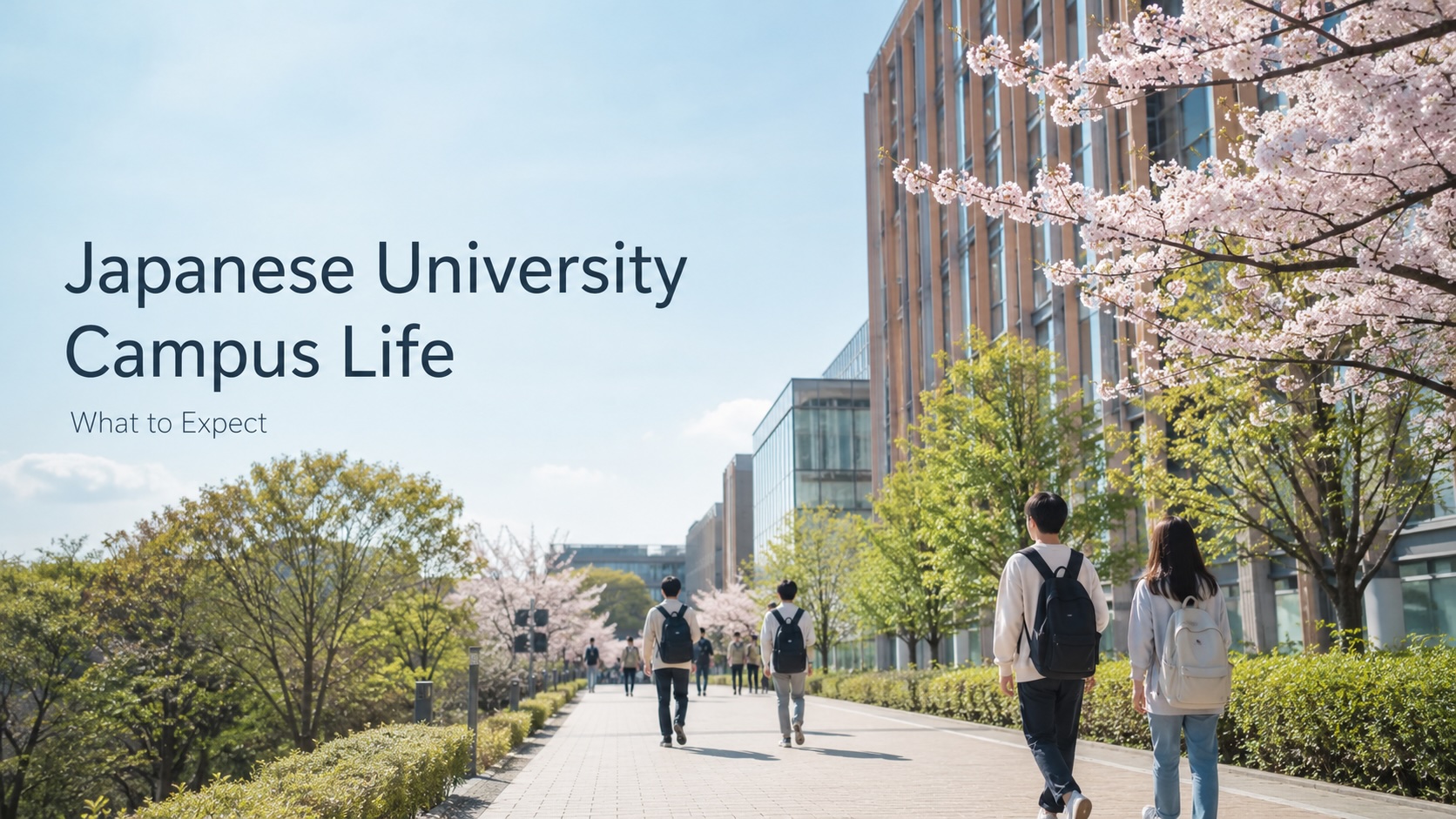
A Day in the Life of a University Student in Japan

A day in the life of a university student in Japan is not the same for everyone. An undergraduate student in Tokyo, a science graduate student in a laboratory, an exchange student in an English program, and a student living in a dormitory may all have different schedules. Still, many students share a common rhythm: commuting, classes, lunch, independent study, club or circle activities, part-time work, and evening preparation.
Quick summary
- Many Japanese university students commute by train, bus, bicycle, or walking, so location strongly affects daily life.
- Class days are often organized around lecture periods, lunch breaks, and gaps between classes.
- Cafeterias and convenience stores are important practical spaces, not only places to eat.
- Circle activities, part-time work, and self-study often happen after classes.
- Graduate students may spend much more of the day in a laboratory or seminar room than in regular lectures.
Morning: commuting and arriving on campus
Many students begin the day by commuting. In urban areas, this may mean taking a train and walking from the station. In large regional campuses, students may use bicycles or buses. A route that looks short on a map can feel different during rainy season, summer heat, or winter mornings, so new students should test the route before the first important class.
Arriving early is useful in Japan because classrooms, offices, and buses can be crowded at certain times. Students who need to print documents, buy stationery, ask an office question, or check a classroom location should avoid arriving at the last minute.
Late morning: lectures, language classes, and practical courses
A typical undergraduate day may include lectures, language courses, experiments, tutorials, or seminars. Some classes are quiet and lecture-based, while others require reports, presentations, discussions, or group work. Students should not assume that all courses at the same university have the same attendance rules or grading style.
International students should check the syllabus and learning management system carefully. Important information may appear in class slides, the student portal, email, or printed handouts. If the course is taught in English, administrative details may still partly appear in Japanese, especially for room changes or general university announcements.
Lunch: cafeteria, convenience store, or packed meal
Lunch is one of the most practical parts of campus life. University cafeterias usually offer meals at student-friendly prices and allow students to eat quickly between classes. The cafeteria is also a good place to observe campus culture: how students line up, choose seats, return trays, and talk with friends.
Some students buy food at a convenience store or campus co-op shop. Others bring a packed meal from home. International students who want to make friends should not underestimate lunch. Repeatedly eating with classmates, lab members, or dormitory friends can create more natural conversations than trying to start deep friendships in the classroom.
Afternoon: self-study, library time, and office visits
After classes, students may go to the library, use a computer room, meet a professor, visit the student affairs office, or prepare assignments. The library is often one of the best places for international students because it provides quiet study space, databases, printers, and a stable routine.
Administrative tasks are also part of daily student life. Course registration, scholarship documents, tuition payment notices, dormitory applications, address changes, and visa-related certificates all require attention. The student who checks deadlines early usually has a much smoother semester.
Evening: circles, part-time jobs, or laboratory work
For undergraduates, evening may mean club or circle activities, part-time work, or homework. Some circles practice several times a week, while others meet casually. Students should ask about the expected frequency before joining, because a group that looks fun may require more time than expected.
For graduate students in science and engineering, the evening may still be research time. Depending on the laboratory, students may continue experiments, data analysis, group meetings, or discussions with senior students. Lab culture varies greatly, so applicants should ask about typical daily schedules before choosing a lab.
Weekends are not always free
Weekends may be used for part-time jobs, club events, fieldwork, laboratory experiments, conference preparation, or personal errands. Some students travel or meet friends, but others use weekends to catch up on study and housework. International students should avoid planning a lifestyle that assumes every weekend will be free.
The most sustainable approach is to create a weekly rhythm: fixed study time, meal planning, laundry, communication with family, exercise, and some social activity. A stable routine is especially important for students living alone for the first time.
Quick comparison
| Situation | Practical meaning |
|---|---|
| Undergraduate student | Classes, lunch, circles, part-time work, and assignments may shape the week. |
| Graduate science student | Laboratory work, seminars, experiments, and meetings may dominate daily life. |
| Exchange student | Courses, language practice, cultural activities, and travel may be more central. |
Final advice
The most important point is to treat Japanese university life as a practical environment, not only an academic label. Before choosing a university, program, laboratory, dormitory, or activity, ask how it will affect your daily routine. A good choice should support your study, communication, health, finances, and long-term goals.
Read next