Classes and Seminars at Japanese Universities: What Makes Them Different?

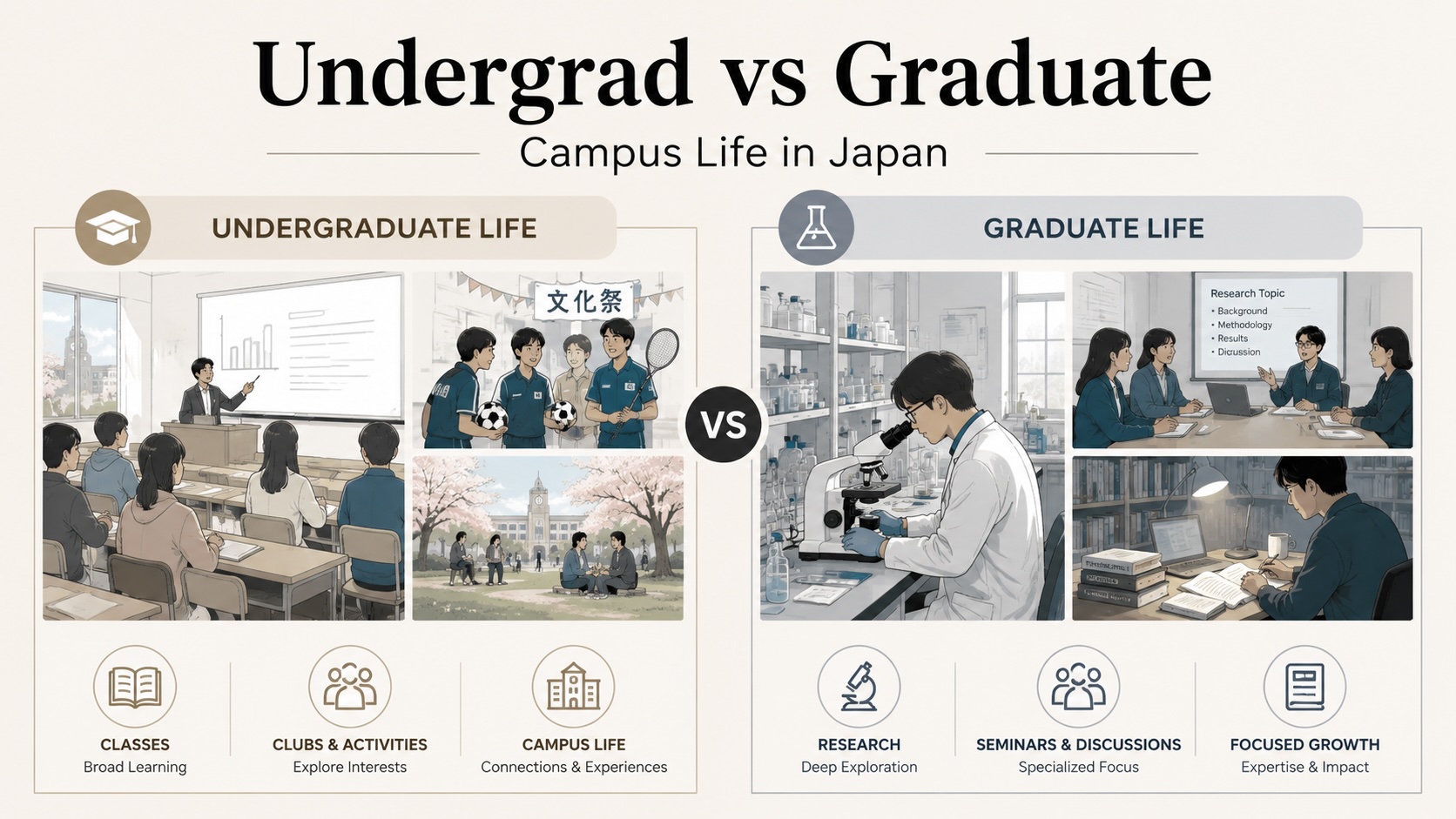
Classes and seminars at Japanese universities can be confusing for international students because the same university may contain many different teaching styles. A large lecture, a small seminar, a language class, a laboratory course, and a graduate research meeting are all part of university education, but they require different behavior and preparation.
Quick summary
- Large lectures may be quiet and teacher-centered, while seminars often require presentation, reading, and discussion.
- Attendance, reports, exams, and participation rules depend on each course, so the syllabus is very important.
- Graduate seminars may focus more on research progress, journal papers, and discussion than on textbook learning.
- International students should learn how to ask questions politely and how to confirm deadlines clearly.
- Classroom culture varies by field: science, engineering, humanities, social sciences, and professional programs may feel very different.
Lecture courses: not all classes are interactive
Many undergraduate lecture courses in Japan are relatively quiet. Students may listen, take notes, and submit reports or take exams. Some teachers ask questions and encourage discussion, but others mainly explain material from slides or handouts. International students from highly interactive classroom cultures should not assume that silence means students are uninterested.
The key is to understand the grading method. Some courses emphasize final exams, while others use weekly reports, quizzes, attendance, presentations, or group work. Read the syllabus carefully and check whether late submission is accepted. In Japan, a small missed deadline can sometimes create a large problem.
Seminars: small-group learning and presentations
A seminar is usually smaller than a lecture and may require students to read papers, prepare presentations, discuss topics, or report progress. In undergraduate programs, seminars may help students enter a specialized field. In graduate programs, seminars may become a central part of research training.
International students should prepare more than just slides. It is useful to prepare possible questions, key vocabulary, and a short explanation of why the topic matters. If the seminar is in Japanese, even simple phrases such as “Could you explain this point again?” or “I am not sure whether I understood correctly” can help.
Experiments, practical courses, and reports
Science and engineering students may take laboratory courses or practical classes. These courses often require punctuality, safety training, teamwork, notebooks, and detailed reports. The report format may be stricter than expected, especially when students must describe methods, results, figures, discussion, and references.
Students should never treat safety instructions casually. In laboratories, Japanese universities may have specific rules for waste disposal, equipment booking, protective glasses, chemical handling, biological samples, and emergency procedures. Asking a teaching assistant or senior student early is better than guessing.
Graduate seminars and research meetings
Graduate seminars are often closer to research training than ordinary classes. Students may present recent papers, explain experimental results, discuss problems, or receive comments from professors and senior students. The atmosphere depends strongly on the laboratory and field.
For master’s and doctoral students, seminar performance can influence how the professor evaluates research progress. It is important to show preparation, honesty about problems, and willingness to improve. A perfect result is not always necessary, but hiding difficulties until the last moment is risky.
How to ask questions and confirm requirements
If you do not understand a course requirement, ask early. A polite email or office-hour question is usually better than waiting until the deadline. Include the course name, your student number if appropriate, the specific assignment, and the exact point you want to confirm.
In class, some students hesitate to ask questions publicly. If the atmosphere feels too quiet, you can ask after class, send an email, or ask a teaching assistant. The important point is to make the question concrete: “Should the report be submitted as PDF?” is much easier to answer than “I do not understand the assignment.”
Quick comparison
| Situation | Practical meaning |
|---|---|
| Large lecture | Listen carefully, check grading rules, and manage exam or report deadlines. |
| Small seminar | Prepare readings, slides, and questions before class. |
| Graduate research meeting | Report progress honestly and discuss next research steps. |
Final advice
The most important point is to treat Japanese university life as a practical environment, not only an academic label. Before choosing a university, program, laboratory, dormitory, or activity, ask how it will affect your daily routine. A good choice should support your study, communication, health, finances, and long-term goals.
Read next