Japanese University Campus Life: What International Students Should Expect
Japanese university campus life can feel calm, organized, and highly convenient, but it may also be less openly social than some international students expect. Much of student life happens through repeated routines: attending classes, eating at the cafeteria, using the library, joining a circle, talking with laboratory members, visiting offices, commuting, and managing daily life around the campus.
Quick summary
- Japanese university campus life is usually safe, orderly, and routine-based, but friendships often develop slowly through repeated shared activities.
- Classes are only one part of campus life. Cafeterias, libraries, offices, clubs, circles, and laboratories matter a lot.
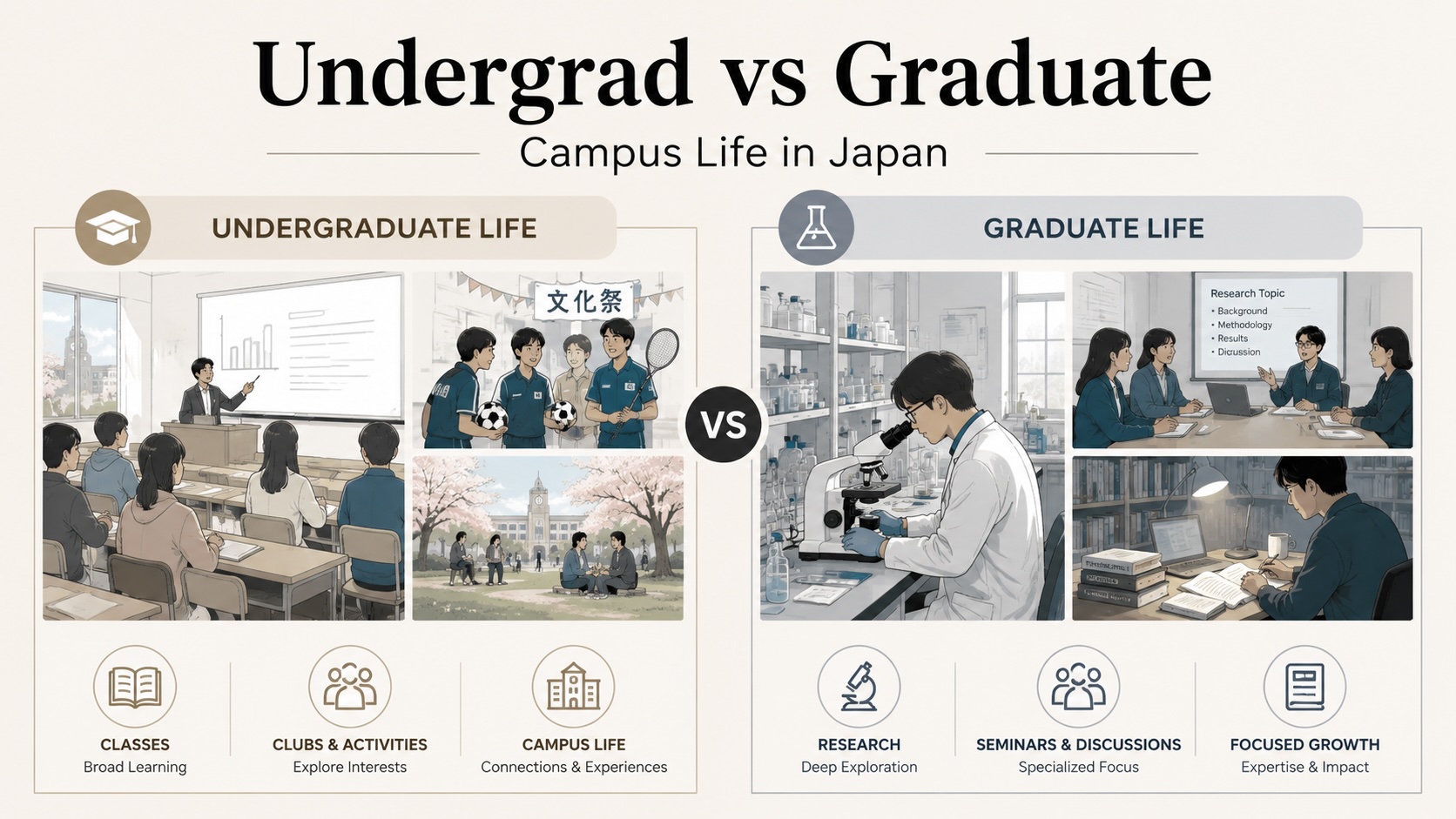
- Undergraduate students often spend more time in lectures and circles, while graduate students, especially in science and engineering, may spend more time in laboratories.
- Japanese ability helps with daily life, but many universities provide English support, especially in international programs.
- The best preparation is practical: learn where offices are, how emails are sent, how class registration works, and how students usually communicate.
What is Japanese university campus life like?
Campus life at a Japanese university is often quieter and more routine-based than visitors imagine. Students may not always talk to strangers freely in classrooms, and social groups can already be formed through departments, clubs, circles, part-time jobs, dormitories, or laboratories. This does not mean that the campus is unfriendly. Rather, many relationships in Japan grow through continuity.
For international students, this means that campus life should be approached as a set of small, repeated opportunities. A short greeting to a classmate, a regular lunch at the same cafeteria, a weekly seminar, a language exchange activity, or a laboratory meeting can gradually become a social connection. Japanese university life often rewards patience and consistency.
Classes, credits, and weekly schedules
In many Japanese universities, undergraduate students take lecture courses, language courses, experiments or practical classes, and seminars. The exact style depends strongly on the university, faculty, and program. Some courses are lecture-based and relatively quiet. Others require presentations, reports, experiments, group work, or discussion. Students should check the syllabus carefully, because attendance rules, grading methods, report deadlines, and exam styles vary by course.
Graduate students often experience a different rhythm. In science and engineering fields, the laboratory may become the center of daily life. In humanities and social sciences, seminars, fieldwork, reading groups, and supervision meetings may be more important. Therefore, university life in Japan can mean very different things depending on whether you are an undergraduate, master’s student, doctoral student, research student, or exchange student.
Cafeterias, libraries, shops, and student spaces
A Japanese university campus usually has practical facilities that support daily life. The cafeteria is often one of the most useful places for international students. It provides affordable meals, a place to meet classmates, and a repeated daily routine. University co-op shops or campus stores may sell stationery, textbooks, snacks, drinks, computer accessories, and sometimes travel or driving-school information.
New students should spend time walking around the campus during the first week. Learn where the student affairs office, international office, health center, library, cafeteria, co-op shop, classrooms, bus stops, bicycle parking areas, and emergency exits are located. This may sound simple, but knowing the campus geography reduces stress when deadlines or problems appear.
Clubs and circles: the social side of campus
Clubs and circles are often a distinctive part of Japanese university campus life. A club may be more serious, with regular training, hierarchy, competitions, or strict participation expectations. A circle is often more casual, though the exact meaning depends on the university and group. Activities may include sports, music, dance, cultural activities, volunteering, language exchange, anime, photography, outdoor activities, and many other interests.
For international students, clubs and circles can be a good way to make friends, but they are not always easy to enter. Some groups mainly use Japanese, have long-established internal customs, or expect frequent participation. Others are very welcoming to international students, especially language exchange, international exchange, culture, sports, and hobby-based groups.
Laboratory life for science and engineering students
For students in science and engineering, laboratory life can be the most important part of Japanese university campus life. In many graduate programs, students belong to a laboratory under a professor or principal investigator. The laboratory may have seminars, research meetings, experiments, equipment training, shared instruments, student desks, and informal conversations with senior students.
Laboratory culture differs greatly from one lab to another. Some laboratories are very international and English-friendly. Others mainly operate in Japanese. Some have clear schedules and regular meetings, while others allow more flexible work styles. Before joining a graduate program, international students should read the lab website, check recent publications, and ask about daily laboratory life during interviews or email communication.
Practical tips for the first month
Read university emails every day, visit the campus before classes become busy, join at least one repeated activity, prepare basic Japanese phrases, and ask senior students practical questions. These simple habits can prevent many problems. In Japan, missing one administrative deadline can create a large amount of extra work, so early checking is important.
Do not stay isolated in English-only spaces. English support is helpful, but campus life becomes richer when you gradually enter Japanese-speaking environments. You do not need perfect Japanese to begin participating. Short greetings, simple questions, and repeated appearances in the same place are often enough to start.
Quick comparison
| Situation | Practical meaning |
|---|---|
| First week | Learn offices, classrooms, cafeteria, library, bus stops, and student portal. |
| First month | Join one repeated activity such as a circle, seminar, lab lunch, or language exchange. |
| Before problems appear | Check email, deadlines, documents, and office hours regularly. |
Final advice
The most important point is to treat Japanese university life as a practical environment, not only an academic label. Before choosing a university, program, laboratory, dormitory, or activity, ask how it will affect your daily routine. A good choice should support your study, communication, health, finances, and long-term goals.
Read next