Can Part-Time Work Cover Your Student Life in Japan?

Many international students in Japan work part-time. It can help pay for food, commuting, phone bills, daily expenses, and some rent. It can also improve Japanese communication skills and give students a better understanding of Japanese workplaces. However, relying on part-time work to cover all tuition, rent, and living costs is usually risky. As of May 2026, official student guidance in Japan clearly warns students not to build a study plan that depends too heavily on part-time income.
Quick summary
- Part-time work can realistically cover part of your monthly living costs, especially food, commuting, phone bills, and daily spending.
- It is usually not safe to assume that part-time work alone can cover tuition, rent, living costs, and savings.
- International students with Student status generally need permission before working and must follow work-hour limits.
- During regular academic terms, the commonly cited limit is up to 28 hours per week, but students should confirm the latest rules with their university and immigration sources.
- Official Study in Japan data reports average part-time earnings of around 81,000 yen per month for privately financed international students.
- A safer plan is to secure tuition and basic living expenses first, then use part-time income as a buffer.
The short answer: helpful, but usually not enough
The practical answer is: part-time work can support your student life in Japan, but it should not be your only financial foundation. If you have a scholarship, family support, savings, tuition exemption, dormitory housing, or low rent, a part-time job can make your life much easier. If you need to pay full tuition, rent, food, utilities, insurance, phone bills, commuting costs, textbooks, and emergency expenses only from a part-time job, the plan becomes fragile.
The official Study in Japan website gives a useful reality check. It warns that claims such as earning 200,000 to 300,000 yen per month while studying are false as a general expectation, and reports average monthly part-time earnings of around 81,000 yen based on JASSO survey data. That number can help with daily life, but it is not the same as a full living-and-tuition budget.
Legal and university limits come first
International students with Student status are in Japan primarily to study. Work is not automatically permitted just because a student has found a job. In general, students need to obtain permission to engage in activities outside their status of residence before working. Universities may also have their own procedures, such as requiring students to report the workplace or consult the international office.
As of May 2026, official and university guidance commonly explains that permitted part-time work is up to 28 hours per week during class periods, with different limits during long school vacations. Students must also avoid prohibited work, including adult entertainment and related businesses. The important point is not only the number of hours. Working without permission, exceeding the limit, or neglecting attendance can affect residence status and continued study in Japan.
Important note
Immigration rules, university policies, and individual permission conditions can change. Before starting any job, check your residence card, permission status, university guidance, and the latest official information. If you are unsure, ask your university's international student office before signing a contract or beginning work.
What monthly income can look like
The actual amount depends on the hourly wage, region, job type, shifts, Japanese ability, and how many hours you can work without damaging your studies. The following examples are simple estimates before tax and deductions. They are not guarantees.
| Work pattern | Example hourly wage | Approximate monthly income | How to think about it |
|---|---|---|---|
| 10 hours/week | 1,200 yen/hour | About 48,000 yen/month | Useful for food, phone, small daily costs, and local transport. |
| 15 hours/week | 1,200 yen/hour | About 72,000 yen/month | A realistic support level for many students if coursework is not too heavy. |
| 20 hours/week | 1,200 yen/hour | About 96,000 yen/month | Can cover a meaningful part of living costs, but may affect study time. |
| 28 hours/week | 1,200 yen/hour | About 134,000 yen/month | Near the usual maximum during class periods; often difficult to combine with demanding study or research. |
In reality, many students do not work the maximum number of hours every week. Exams, laboratory work, thesis deadlines, illness, travel, university events, and employer shift schedules all reduce actual income. A budget based on the maximum possible work hours is therefore less safe than a budget based on moderate and repeatable work hours.
Compare income with actual student costs
Study in Japan reports an average monthly living cost of 105,000 yen for international students, excluding the cost of study and research, based on the 2023 Lifestyle Survey of Privately-Financed International Students. The same page notes that rent is higher in Tokyo and other large cities than in more rural areas.
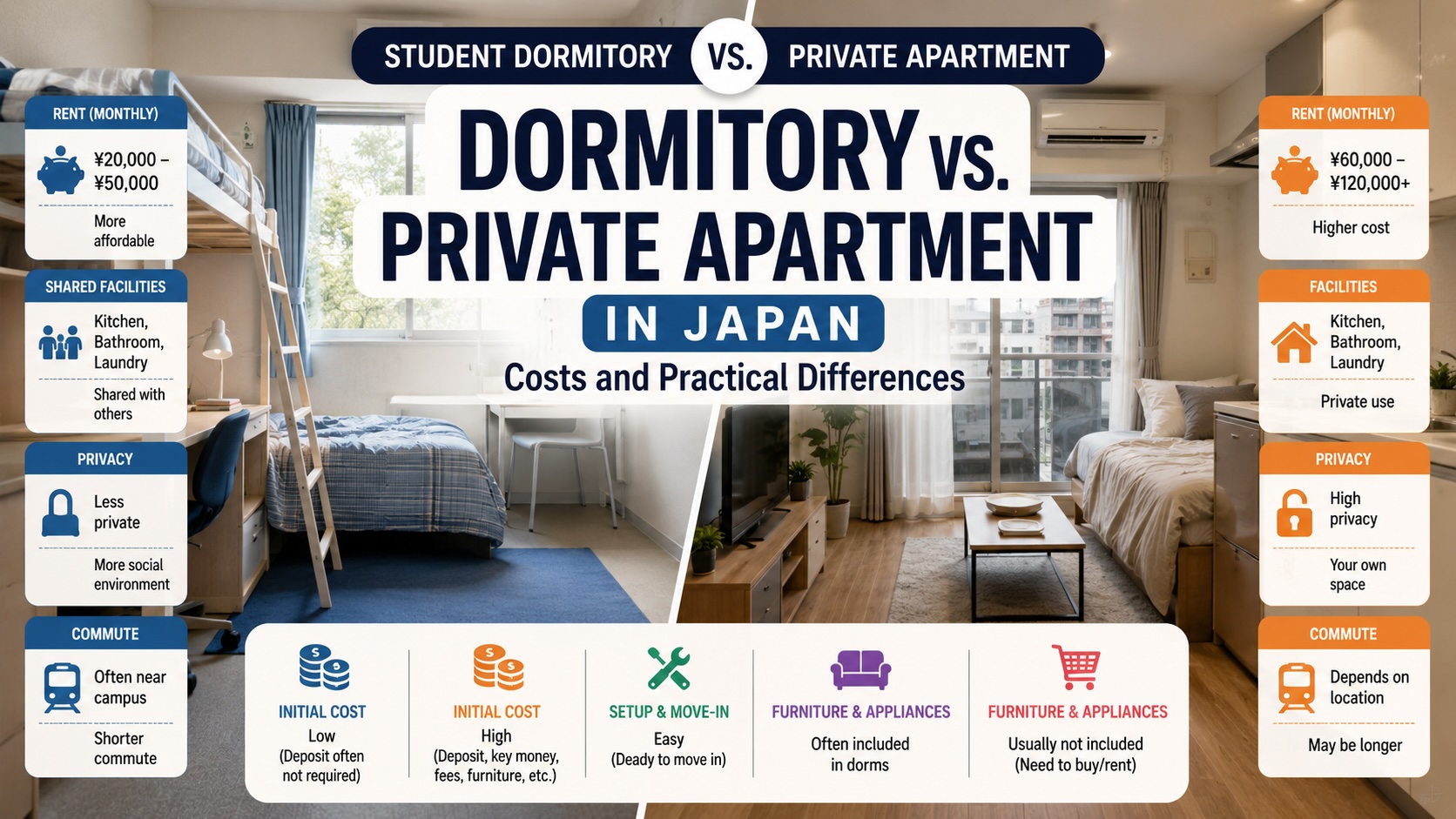
This means that an average part-time income can be close to ordinary monthly living expenses in a low-cost situation, but several costs can easily push the budget above that level. Rent in private apartments, utility bills, initial moving costs, tuition, admission fees, laboratory-related travel, health insurance, and emergency expenses are not small details. They decide whether the plan is comfortable or stressful.
| Student situation | Part-time work may cover... | Part-time work is unlikely to cover... |
|---|---|---|
| Dormitory or low rent, scholarship for tuition | Food, phone, transport, daily spending, some savings | Large unexpected costs without backup savings |
| Private apartment in a large city | Part of rent and daily costs | Full rent, full living costs, tuition, and emergency costs together |
| Graduate student in a busy laboratory | Supplemental income if shifts are limited and predictable | A maximum-hour work schedule during experiments, seminars, and thesis periods |
| Language school or undergraduate student with fixed classes | Evening or weekend income if attendance remains stable | A plan that sacrifices attendance, sleep, or exam preparation |
Common student jobs and what they mean
Official Study in Japan data lists restaurant work and sales as common job categories for international students. These jobs are relatively accessible because they often need shift workers. However, they can also involve standing for long periods, late hours, customer service, and Japanese communication under time pressure.
For students with stronger Japanese or technical skills, other options may exist: teaching or research assistant work, translation, interpretation, tutoring, hotel work, office support, or work connected to the university. These can be more compatible with academic life, but they are not always available and may require higher language ability or a recommendation from a supervisor.
Practical differences between job types
- Convenience stores and supermarkets: Good for routine Japanese, but shifts can be physically tiring.
- Restaurants and cafes: Useful for spoken Japanese and teamwork, but late shifts may affect sleep.
- Tutoring and language teaching: Often better paid, but hours may be limited and irregular.
- TA or RA work: Academically useful, but availability depends on the university, laboratory, project, and student status.
- Translation or interpretation: Good for advanced bilingual students, but not a stable option for everyone.
The hidden cost is study time
The biggest cost of part-time work is not only fatigue. It is the loss of flexible study time. A student may think that 15 or 20 hours per week is manageable, but the actual burden includes commuting to work, changing clothes, preparing for shifts, recovering afterward, and adjusting study plans around the employer's schedule.
This is especially important for graduate students. Laboratory schedules are not always fixed. Experiments may fail, equipment time may become available suddenly, group meetings may require preparation, and thesis writing can become intense near deadlines. A part-time job that is fine in the first month may become difficult during research-heavy periods.
For this reason, the most sustainable approach is often to start with fewer hours, understand your academic rhythm, and then increase shifts only if your grades, attendance, sleep, and research progress remain stable.
A safer budgeting strategy
A realistic student budget should separate essential fixed costs from flexible daily costs. Essential fixed costs include tuition, rent, insurance, visa-related expenses, and basic utilities. Flexible costs include eating out, entertainment, short trips, clothes, hobbies, and some transport. Part-time income is much safer when it is used mainly for the flexible side of the budget.
A practical budget rule
- Secure tuition and minimum rent before arrival through savings, scholarship, family support, or another stable source.
- Use part-time income for food, transport, phone bills, daily spending, and a small emergency buffer.
- Do not assume you can work the legal maximum every week while maintaining good academic performance.
- Keep at least several months of essential expenses separate from your expected part-time income.
- Recalculate your budget after your first two or three months in Japan, when your real costs become clearer.
If your budget works only when you work 28 hours every week, it is too tight for most students. If your budget works when you work 10 to 15 hours per week, and extra shifts simply make life more comfortable, it is much more realistic.
When part-time work works well
Part-time work can be very positive when it is used in the right way. It gives students a reason to use Japanese outside the classroom, learn workplace manners, understand customer service, and meet people outside the university. For students who want to work in Japan after graduation, even a simple student job can be useful cultural training.
It works best when the job has predictable shifts, a reasonable commute, a manager who understands student schedules, and a workload that does not damage sleep or attendance. A job near campus or near home is often better than a slightly higher-paid job that requires a long commute. In Japan, small differences in commuting time can strongly affect daily energy.
Warning signs that you are relying too much on work
Students sometimes notice the problem only after their study performance declines. The warning signs are easy to ignore at first, but they matter.
- You regularly miss morning classes or laboratory activities after late shifts.
- You cannot study for exams unless you cancel work shifts.
- You are afraid to reduce shifts because rent or tuition depends on them.
- You have no savings for illness, moving costs, visa procedures, or family emergencies.
- Your supervisor, classmates, or university office has commented on attendance or progress.
- You are choosing jobs mainly by hourly wage, without checking safety, legality, or schedule stability.
If several of these apply, it is better to adjust early. Talk with the university office, check scholarship or tuition reduction options, reduce fixed costs, or move to a less expensive housing situation if possible.
Practical conclusion
Part-time work in Japan is best understood as a support tool, not a complete funding strategy. It can make student life more comfortable, reduce pressure on savings, improve Japanese, and provide useful workplace experience. It can also cover a meaningful part of monthly expenses, especially in a low-rent situation.
However, students should not plan to finance everything through part-time work. A safer plan is to prepare tuition and basic living costs first, then use part-time income to support daily life. If you can study without working the maximum permitted hours, your academic and financial plan is much more stable.
Bottom line
Part-time work can help cover student life in Japan, but it usually should not be the main pillar of your study-abroad budget. Build your plan so that your studies can continue even if your shifts are reduced during exams, research deadlines, illness, or visa procedures.
Useful official sources
Rules and costs can change, and details vary by university and residence status. Check official sources and your university office before relying on part-time work in your financial plan.
- Study in Japan: Part-Time Work
- Study in Japan: Living Costs and Expenses
- Study in Japan: Status of Residence
- JASSO: Life in Japan
- Ministry of Health, Labour and Welfare: Regional Minimum Wages
- Your university's international student office
- Your graduate school or faculty student affairs office
Read next