Japan vs. Europe and the United States: Is Japan a Good Choice for Science and Engineering Students?
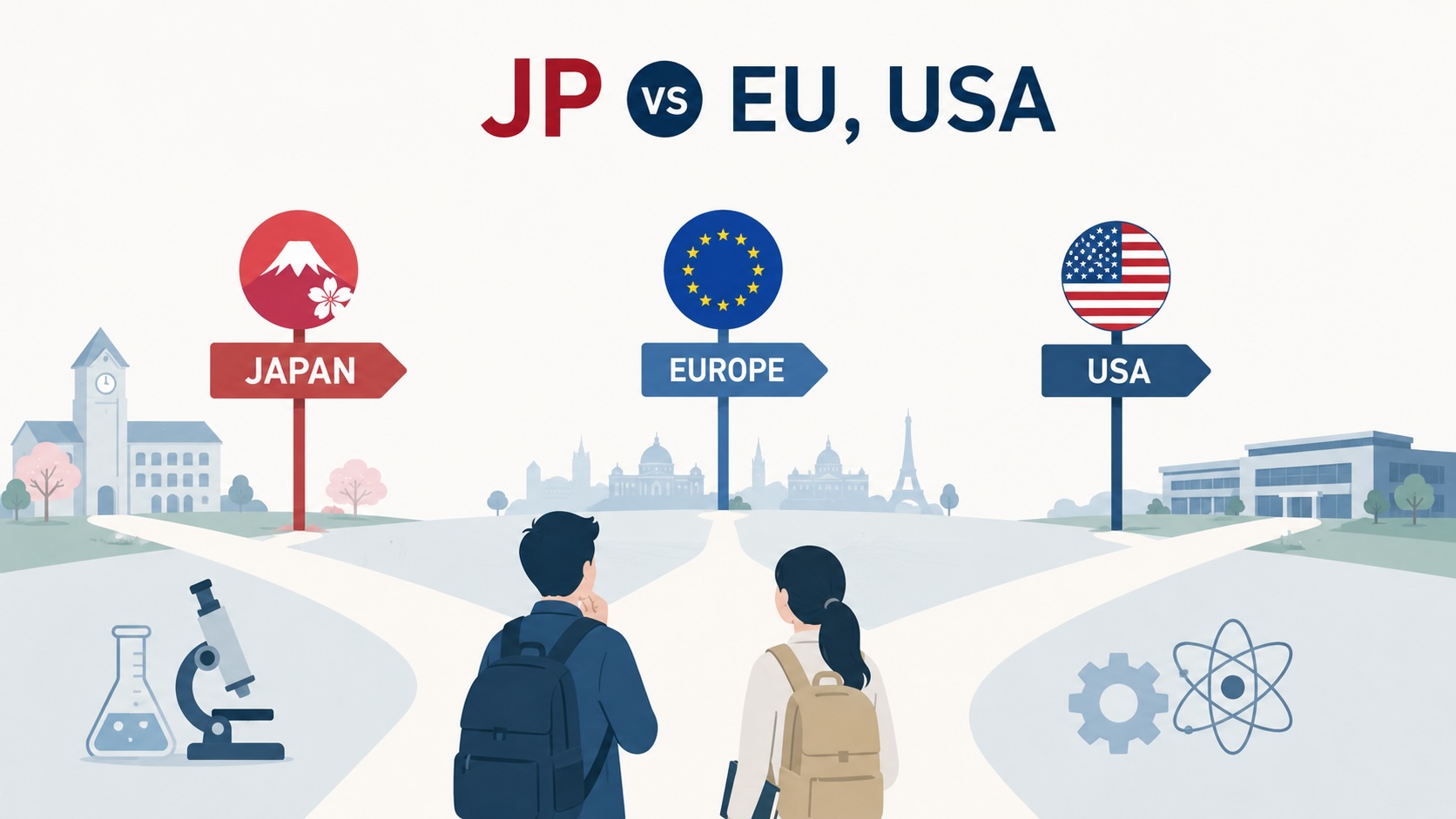
When students compare Japan with Europe and the United States, the discussion often begins with university rankings. Rankings are useful, but they do not tell the whole story. For science and engineering students, Japan can be a serious and practical option because it combines strong research traditions in chemistry, physics, materials science, and engineering with relatively safe daily life, stable infrastructure, and often more manageable costs than many U.S. or large-city European options.
Quick summary
- The United States has many of the world’s most visible elite universities, large research budgets, and powerful industry networks.
- Europe offers excellent public universities, strong mobility within the region, and high-quality research environments that vary greatly by country.
- Japan is especially worth considering for students in chemistry, materials science, physics, mechanical engineering, robotics, electronics, and manufacturing-related fields.
- Japan’s advantages are not only academic: safety, public transportation, clean cities, predictable systems, and student-friendly national university tuition can matter greatly in daily life.
- The main challenges in Japan are language, fewer English-only environments, lower global name recognition outside Asia, and the need to choose the laboratory carefully.
Why this comparison should not be only about rankings
If your only goal is to attend the highest-ranked university that admits you, the United States and parts of Europe will naturally appear very attractive. Many globally famous universities are located in the U.S., the United Kingdom, Switzerland, Germany, the Netherlands, France, and other European countries. These institutions often have strong international visibility, large alumni networks, and highly developed English-language ecosystems.
However, a student’s success is not determined by a university name alone. Research students need a supervisor who is available, a laboratory that fits their topic, enough funding to live, access to instruments, a stable daily routine, and a safe environment where they can concentrate for several years. A lower-ranked university with the right laboratory can be better than a famous university where the student is isolated, underfunded, or mismatched with the research group.
This is where Japan deserves a careful look. Japan may not always dominate general university rankings, but it has deep research traditions, strong national universities, advanced laboratories, and industrial strengths that are highly relevant to science and engineering students. The question is not “Is Japan better than the U.S. or Europe?” The better question is: “For my field, budget, lifestyle, and career plan, could Japan be the most realistic and stable choice?”
Japan, Europe, and the U.S. at a glance
| Point to compare | Japan | Europe | United States |
|---|---|---|---|
| Research visibility | Very strong in selected science and engineering fields, but global visibility depends heavily on university, laboratory, and professor. | Very strong across many countries, especially in public research universities and national research institutes. | Extremely strong global visibility, especially at top research universities and private institutions. |
| Cost and tuition | National university tuition is often more predictable and moderate than many U.S. options, although private universities and future fee changes should be checked. | Varies widely by country; some public systems are affordable, while some English-taught or non-EU tuition can be high. | Can be very expensive, especially without scholarships, assistantships, or tuition waivers. |
| Daily safety | Generally one of Japan’s strongest advantages for students, especially for ordinary commuting, late laboratory work, and daily city life. | Very country- and city-dependent; many places are safe, but the situation varies more than many applicants expect. | Highly variable by city, campus, and neighborhood; safety should be checked locally rather than assumed from university reputation. |
| English environment | Improving, especially in graduate programs, but daily life often still benefits greatly from Japanese ability. | Strong in many northern and western European countries; more variable in southern and eastern Europe. | Strongest English environment for most international students. |
| Industry connection | Strong in manufacturing, materials, automotive, electronics, chemicals, robotics, and precision engineering. | Strong in pharmaceuticals, engineering, energy, automotive, aerospace, and advanced manufacturing, depending on country. | Strong in technology, biotechnology, AI, semiconductors, startups, and venture-backed innovation ecosystems. |
| Best fit for | Students who value safety, stable daily life, strong STEM laboratories, and a focused research environment. | Students who want regional mobility, multilingual and international environments, and strong public research systems. | Students seeking maximum global visibility, English immersion, and access to large research and industry ecosystems. |
Living conditions: Japan can be easier than many students expect
Living conditions matter because science and engineering degrees are long. A master’s or PhD student may spend years commuting to campus, working late in the laboratory, managing experiments, and living on a scholarship or assistantship. A country that looks attractive academically can become difficult if rent, healthcare, transportation, or safety create constant stress.
Japan’s daily-life advantage is predictability. Public transportation is generally reliable, cities are clean, convenience stores and basic services are widely available, and many university towns are designed around commuting students. In many regions outside central Tokyo, students can live close to campus at a more manageable rent than in global cities such as New York, Boston, London, Paris, Amsterdam, or Zurich.
Japan is not always cheap. Tokyo, Kyoto, Osaka, and other large cities can be expensive, and the weak or strong yen can change the feeling of affordability depending on your home currency. Still, the combination of moderate national university fees, relatively efficient public transport, and the possibility of living in regional university cities can make Japan financially realistic for many students.
Safety: an important but often underestimated academic factor
Safety is not a small lifestyle detail. It affects whether students feel comfortable returning from the laboratory at night, commuting alone, carrying a laptop, using public transportation, or living in a modest apartment near campus. For graduate students who often work irregular hours, this can directly affect research productivity and mental comfort.
Japan’s safety is one of its strongest advantages. International comparisons consistently place Japan among the safer and more peaceful large developed countries. Many European countries are also very safe, but Europe is not one uniform environment: safety, housing, political atmosphere, and daily stress differ greatly between countries and even between cities. In the United States, the difference between a safe campus town and a high-risk neighborhood can be large, so students must check the local situation carefully.
This does not mean Japan has no problems. Natural disasters, summer heat, language barriers in emergencies, and mental isolation are real issues. However, for ordinary daily crime risk, commuting, and general public order, Japan can be very attractive for international students, especially those who are living abroad for the first time.
Research strengths: Japan is particularly strong in several STEM fields
Japan should not be judged only by overall university rankings. Its strength is often field-specific and laboratory-specific. In chemistry, materials science, physics, electronics, mechanical engineering, robotics, precision manufacturing, nanotechnology, catalysis, polymers, semiconductors, and energy-related research, Japan has long-standing academic and industrial depth.
Chemistry and materials science are especially important. Japan has a strong tradition in synthetic chemistry, physical chemistry, polymer science, supramolecular chemistry, catalysis, analytical chemistry, electrochemistry, and functional materials. Many Japanese laboratories also have close connections with chemical, materials, pharmaceutical, electronics, and manufacturing companies, which can be valuable for students who want research training connected to real technologies.
Physics and engineering also have strong foundations. Japan has major research universities, national institutes, synchrotron and accelerator facilities, advanced microscopy and nanofabrication environments, and internationally known companies in electronics, optics, robotics, automotive engineering, and precision instruments. For students whose research depends on instruments, fabrication, or careful experimental technique, Japan can be a particularly good environment.
Japan compared with the United States
The United States is difficult to beat in global university visibility. It has many of the world’s most famous universities, large-scale graduate programs, strong assistantship systems in many STEM fields, powerful industry connections, and a huge English-speaking academic ecosystem. For students who can obtain full funding at a strong U.S. research university, the opportunity can be excellent.
The risks are also real. Tuition and living costs can be high, healthcare and insurance systems can be confusing, and safety varies sharply by location. Graduate student life can also be highly competitive and stressful. In some cases, the university name is strong but the individual student’s daily life is financially or psychologically difficult.
Japan may be a better fit for students who prefer a smaller, more stable, and more laboratory-centered environment. It may also be attractive for students who want to study advanced experimental science without taking on very high living costs. The trade-off is that Japan usually requires more adaptation to language and local academic culture.
Japan compared with Europe
Europe is not one system. Germany, France, Switzerland, the Netherlands, Sweden, Finland, Italy, Spain, Poland, and the United Kingdom all offer different combinations of tuition, safety, English use, research funding, visa rules, and job opportunities. Some European countries provide excellent public education at relatively low tuition. Others are expensive, especially for non-EU students or in large cities.
Europe’s strengths include international mobility, strong public research institutes, cross-border collaboration, and a large number of English-taught graduate programs. For students who want to move between countries, attend international schools, or enter a European labor market, Europe can be very attractive.
Japan may be more attractive for students who want a highly organized, safe, and technologically advanced environment in Asia. It can also be a strong option for students interested in Japanese industry, East Asian research networks, or fields where Japanese laboratories and companies have deep expertise. The main disadvantage is that English-only life is usually easier in many parts of Europe than in Japan.
Cost, tuition, and funding: check the actual laboratory and university
Cost comparisons can be misleading if you only compare national averages. In Japan, national university tuition has historically been relatively standardized, while private university fees vary more. In Europe, tuition depends heavily on country, nationality, degree level, and language of instruction. In the United States, the difference between a fully funded PhD and an unfunded master’s program is enormous.
For graduate students, the most important question is not only tuition. You should ask whether the laboratory has funding, whether tuition waivers are possible, whether scholarships are realistic, whether paid research assistant positions exist, and whether the stipend is enough for the city. A Japanese laboratory with reliable funding and a moderate-cost city can be more realistic than a famous program where living costs exceed your support.
Students should also remember that funding systems differ by level. PhD programs, master’s programs, research students, exchange students, and privately financed international students may face different costs and support options. Before applying, confirm the actual tuition, admission fee, scholarship possibilities, housing support, and expected monthly expenses directly with the university or supervisor.
Language and academic culture: Japan requires preparation
The largest practical challenge in Japan is language. Many graduate laboratories can supervise research in English, especially in science and engineering. However, daily life outside the laboratory often requires Japanese: city hall procedures, housing, banks, clinics, part-time work, mobile phone contracts, and neighborhood communication.
Academic culture can also differ. Japanese laboratories may place strong emphasis on careful experimental work, regular progress reporting, group responsibility, hierarchy, and long-term trust with the supervisor. Some students appreciate this structure because it supports steady research progress. Others may prefer the more independent or debate-oriented atmosphere often found in parts of the U.S. or Europe.
The best strategy is not to assume that “Japan” has one uniform academic culture. Laboratory culture differs greatly by professor, field, university, funding situation, and international experience. Before joining a laboratory, communicate with current students if possible and check how the supervisor manages meetings, publications, working hours, authorship, and career support.
Who should seriously consider Japan?
Japan is not the best choice for every student. However, it can be a very strong choice for students with the following priorities.
- You are in chemistry, materials science, physics, mechanical engineering, electrical engineering, robotics, nanotechnology, optics, catalysis, polymers, semiconductors, or related fields.
- You value daily safety, clean infrastructure, reliable public transportation, and a stable study environment.
- You want to avoid extremely high tuition or living costs, especially compared with many U.S. private universities or major global cities.
- You are interested in Japanese industry, manufacturing, materials, electronics, robotics, or long-term work in Japan.
- You are willing to learn practical Japanese and adapt to a more local academic and social environment.
- You have identified a specific Japanese laboratory that matches your research topic and has realistic funding or scholarship possibilities.
Who should be more careful?
Japan may be less suitable if you need a fully English-speaking environment for both university and daily life, if you strongly prefer a Western-style debate culture, or if your career target is mainly in the U.S. or European labor market. It may also be less suitable if you choose only by university name without checking the laboratory, supervisor, funding, and city.
Students should also be careful if they are applying to a program where English information is limited, scholarships are uncertain, or the professor’s expectations are unclear. Japan can be a very good option, but it rewards careful preparation. The best outcomes usually come from choosing a specific laboratory intentionally, not from choosing Japan in a vague way.
Practical conclusion
Japan does not need to be “better” than Europe or the United States to be a good choice. For many science and engineering students, it is enough that Japan offers a strong combination of research depth, safety, manageable daily life, advanced infrastructure, and realistic cost. If your field matches Japan’s strengths and you choose the laboratory carefully, Japan can be not a backup option, but a genuinely strategic destination.
Checklist before choosing Japan, Europe, or the U.S.
- Compare laboratories and supervisors before comparing university names.
- Check whether your exact field is strong at the target university, not only whether the university is famous overall.
- Confirm tuition, admission fees, scholarship probability, stipend amount, and expected monthly expenses.
- Check rent near the actual campus, not only the average cost of the country.
- Look at safety at the city and neighborhood level, especially if you may work late in the laboratory.
- Ask whether English is enough for research meetings, administrative procedures, and daily student life.
- Contact current or former students to understand laboratory culture and supervisor style.
- Think about your career after graduation: academia, local industry, global companies, or returning to your home country.
- Do not treat Japan, Europe, or the U.S. as a single category. The real comparison is between specific universities, laboratories, cities, and funding packages.
Useful sources for further checking
- Study in Japan: Academic Fees
- Study in Japan: Living Costs and Expenses
- Global Peace Index 2025
- Nature Index: Japan country output
- OECD Economic Surveys: Japan 2024
Read next