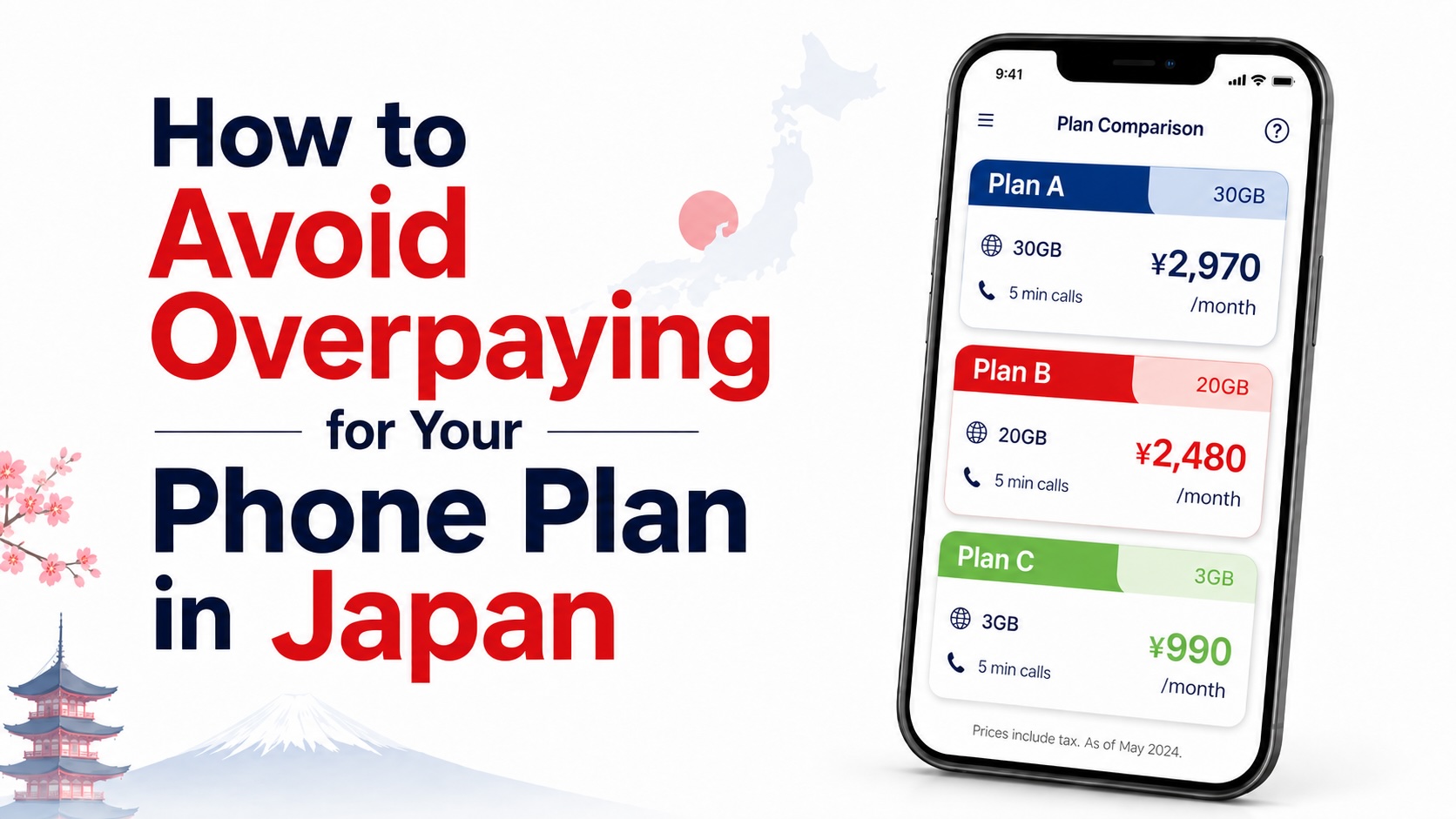
How to Avoid Overpaying for Your Phone Plan in Japan
A mobile phone is essential in Japan. You may need a Japanese phone number for bank accounts, delivery services, part-time work, university administration, apartment contracts, and two-factor authentication. However, this does not mean you must choose an expensive shop-based contract with a new phone. For many international students, researchers, and professionals, the best approach is to separate three questions: Do I need a Japanese number? How much data do I actually use? and Do I need English or in-store support?
Quick summary
- Do not start by buying a new phone. Start by checking whether your current phone is unlocked and compatible.
- If you mostly use campus, office, or home Wi-Fi, a small or medium data plan may be enough.
- Online plans and MVNOs can be much cheaper than traditional full-service carrier contracts.
- English-support SIM providers can be worth paying for when you first arrive, but they are not always the cheapest long-term option.
- Be careful with device installments, home internet bundles, family discounts, paid call options, insurance, and shop-support add-ons.
Why people overpay for phone plans
People often overpay in Japan not because mobile service is always expensive, but because they choose a plan before understanding their own needs. A student may sign up for a large-data plan even though most communication happens on university Wi-Fi. A researcher may buy a new phone together with a carrier contract because it feels easier. A newcomer may choose a service with English support and continue using it for years even after they no longer need that level of assistance.
The important point is that the first plan you use after arrival does not have to be your permanent plan. It can be reasonable to start with a simple, foreigner-friendly service for the first weeks or months. After you have an address, bank account, credit card or debit card, and a better sense of your data usage, you can compare cheaper long-term options.
Start with your phone, not the contract
Before choosing a plan, check whether your current smartphone can be used in Japan. The key points are whether it is unlocked, whether it supports Japanese network bands, whether it can use eSIM if you want eSIM, and whether voice calls will work properly. This is especially important if you bring an Android phone from outside Japan.
If your phone works, a SIM-only or eSIM plan can be much cheaper than buying a new device through a carrier. If your phone does not work well in Japan, compare the total cost of buying an unlocked phone separately with the total cost of a carrier device bundle. The monthly price can look reasonable while the device installment quietly makes the overall cost much higher.
Estimate your real data use
Many students and researchers do not need very large mobile data plans. If you have Wi-Fi at home, at university, in the laboratory, or at work, your monthly mobile data use may be much smaller than you expect. Heavy users are different: if you often watch videos outside, tether a laptop, use online meetings on mobile data, or commute for a long time while streaming, you may need more data.
| Your situation | What to consider |
|---|---|
| Mostly Wi-Fi | A low-data or medium-data plan may be enough. Avoid paying for data you rarely use. |
| Daily video or gaming outside | Compare larger data plans carefully, including speed restrictions after the limit. |
| Frequent tethering | Check whether tethering is allowed and whether your plan has enough data for laptop use. |
| Mostly calls and SMS verification | A voice plan with a Japanese number may matter more than large data capacity. |
Main types of phone plans in Japan
Japan has several practical categories of mobile plans. Large carriers and their online brands often provide stable network quality and simple pricing. MVNOs can be cheaper, especially for moderate data users. English-support SIM companies can be helpful for newcomers who need setup assistance, airport pickup, or payment support using an overseas card.
| Option | Typical advantage | Possible drawback |
|---|---|---|
| Major carrier full-service plans | Strong shop support, device sales, family or internet bundles. | Can become expensive if you do not need the bundle or shop support. |
| Online carrier brands | Simple pricing, major-carrier networks, often good value. | Application and support may be mostly online and partly Japanese. |
| MVNOs | Often low monthly fees for light or moderate users. | Speed, support, and payment requirements vary by provider. |
| Foreigner-friendly SIM providers | English support, easier setup, useful immediately after arrival. | May cost more than Japanese-language low-cost plans in the long run. |
| Data-only eSIM | Fast setup and useful for short stays or backup data. | Usually not enough if you need a Japanese phone number. |
A practical approach
For your first month in Japan, simplicity may be worth paying for. For your second or third month, compare cheaper long-term options after you understand your actual data use and support needs.
Current examples to use as reference points
Price and plan information in this section is based on publicly available information as of May 2026. Mobile plans can change, so always check the provider’s official website before signing a contract.
Do not choose a plan only because someone online says it is cheap. Instead, use current well-known plans as reference points. For example, as of May 2026, ahamo lists a simple 30 GB plan at 2,970 yen per month with 5-minute domestic calls included, while povo2.0 uses a topping system in which there is no fixed monthly data plan and users purchase data capacity as needed. Rakuten Mobile advertises a tiered plan with a low price for small data use and a higher capped price for unlimited data, while LINEMO and IIJmio offer lower-data options that may suit light users.
These examples are useful because they show the range of ordinary prices in Japan. If someone is proposing a much more expensive plan, ask what extra value you are getting: a new phone, in-store support, unlimited data, call options, home internet discount, insurance, or an English support layer. Those extras may be useful, but they should be intentional.
When English support is worth paying for
English support is not a luxury if you are new to Japan, have just arrived, or cannot yet handle Japanese-language application forms. A phone problem in your first week can affect your bank account, apartment setup, university communication, and delivery services. In that situation, a service with English setup support can be a practical temporary choice.
However, after you are settled, English support should be treated as one feature among many. If your plan is significantly more expensive than Japanese-language options and you rarely contact support, switching later may make sense. The goal is not to choose the absolute cheapest plan from day one. The goal is to avoid staying in a high-cost beginner plan after you no longer need it.
Be careful with bundles and extras
The most expensive phone contracts often become expensive through additions. A base plan may look acceptable, but the total monthly bill can increase through a device installment, insurance, call option, streaming service, cloud storage, shop-support plan, or home internet bundle. Some discounts also require family lines, specific credit cards, or home internet contracts that international students and short-term researchers may not have.
Before signing, ask yourself whether each add-on solves a real problem. If you rarely call normal phone numbers, a large call option may be unnecessary. If you already own a good phone, a new device installment may be unnecessary. If you live in university housing or a short-term apartment, a home internet bundle may not fit your situation.
Common traps
- Buying a new phone before checking your current phone. A compatible unlocked phone can save a large amount of money.
- Choosing unlimited data by default. Unlimited data is useful for some people, but many students mainly use Wi-Fi.
- Ignoring the need for a Japanese phone number. Data-only eSIMs are convenient, but they may not work for bank accounts, delivery forms, or SMS verification.
- Overvaluing the first plan you find in English. English support can be useful at first, but compare again after arrival.
- Forgetting cancellation and transfer rules. Check whether you can cancel online, keep your phone number, and switch without large costs.
- Not checking payment methods. Some plans may require a Japanese credit card, bank account, or identity verification documents.
A simple decision process
- Check whether your current phone is unlocked and compatible with Japanese networks.
- Decide whether you need a Japanese phone number or only data.
- Estimate your monthly data use after considering home, university, and workplace Wi-Fi.
- Decide how much support you need in English or in person.
- Compare at least three options: one major online plan, one MVNO or low-cost SIM, and one English-support provider.
- Check the total monthly cost, not only the advertised base price.
- Set a reminder to review your plan after two or three months in Japan.
Final checklist
- Is your phone unlocked?
- Does your phone support Japanese network bands and VoLTE if needed?
- Do you need a Japanese phone number?
- How much mobile data do you actually need outside Wi-Fi?
- Are call options necessary for your lifestyle?
- Are device installments, insurance, or entertainment add-ons included?
- Can you apply with your current ID, address, payment method, and language ability?
- Can you cancel or switch easily if your situation changes?
Important note
Mobile plans, campaigns, discounts, data amounts, and application requirements change frequently. This article gives a practical way to think about costs, not a fixed ranking of carriers. Always confirm the latest official conditions before applying.
Useful sources to check
- ahamo: Plan and data amount
- povo2.0: Topping list
- Rakuten Mobile: English plan information
- LINEMO: Plan information
- IIJmio: Giga Plan
- Sakura Mobile: English-support SIM and eSIM options
- Mobal: Japan SIM card plans
Read next
- Saving Money in Japan: How to Spend Less on Food and Drink
- Salary and Taxes in Japan: Basic Concepts for Foreign Professionals
- Japanese Rental Terms Explained: Shikikin, Reikin, and Cleaning Fees
Read next