Is Japan Really Safe? A Practical Guide for International Students and Professionals
If your alternatives are Europe or the United States, Japan is usually one of the safest major destinations for studying, research, and professional life. This is especially true for ordinary daily routines: commuting by train, walking around a university area, living alone, using public spaces, and building a quiet study-focused life. Safety should not be the only reason to choose a country, but for international students and professionals who need a stable environment, Japan has a very strong advantage.
Quick summary
- Japan is generally much safer than the United States and safer than many popular European destinations for everyday student and professional life.
- The clearest difference is violent crime. Japan’s intentional homicide rate is exceptionally low among large developed countries.
- Safety in Japan is not only about serious crime. Pickpocketing, bag snatching, street fights, and aggressive public trouble are relatively uncommon in ordinary student and work routines.
- In practice, newcomers can usually commute, shop at convenience stores at night, ask police or nearby people for help, and relax during daily travel as long as they behave considerately.
- A fair comparison should still include Japan-specific risks, especially earthquakes, typhoons, summer heat, scams, harassment, and language barriers in emergencies.
The short answer: yes, Japan is genuinely very safe
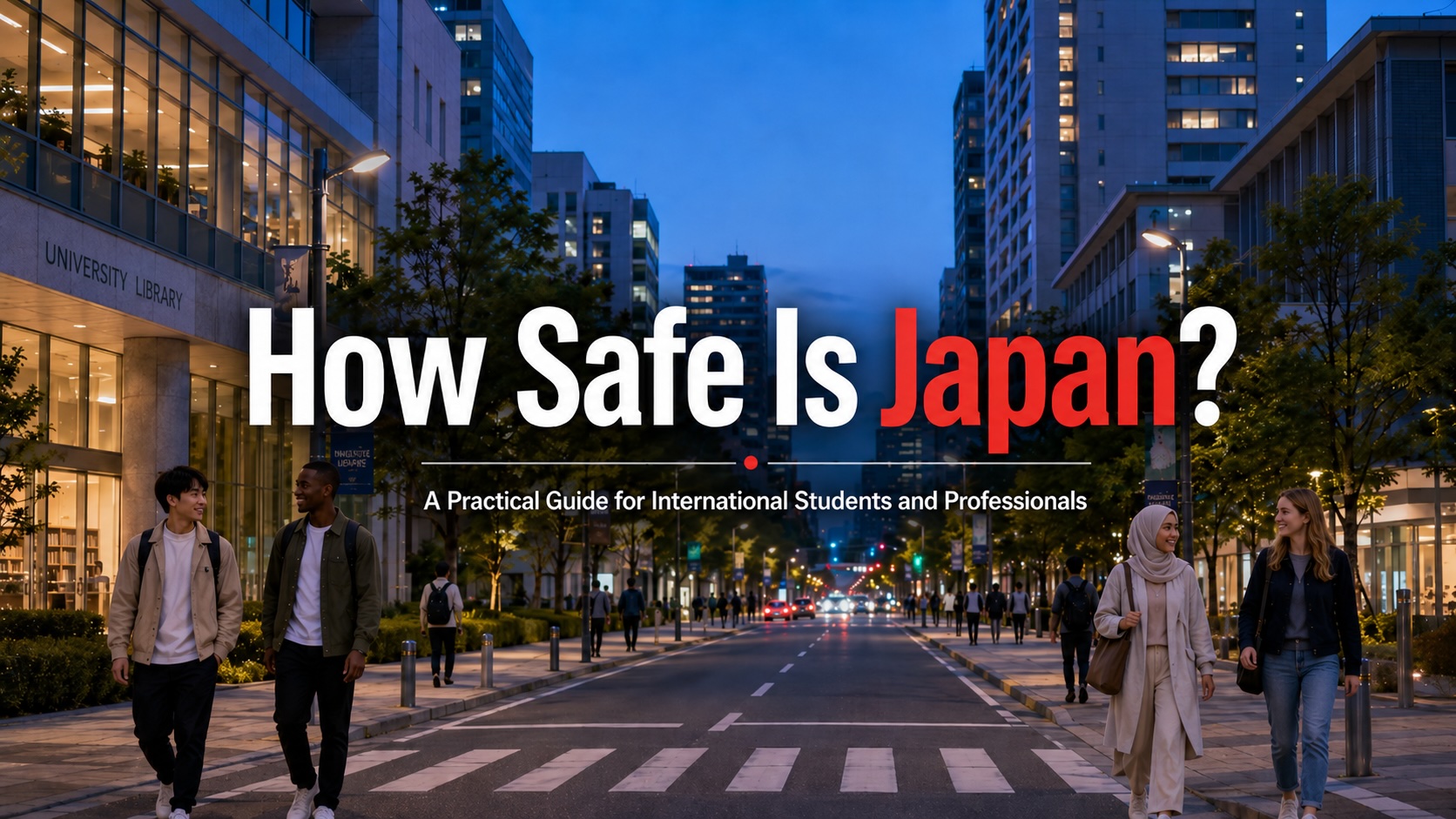
Japan’s reputation for safety is not just a stereotype. For most international students and professionals, daily life in Japan is calm, orderly, and predictable. It is common to see students commuting alone, people walking to stations at night, children using trains, and small shops or convenience stores operating late into the evening.
This does not mean every city, neighborhood, person, or situation is perfect. However, compared with many places in the United States and many large European urban areas, Japan usually offers a lower-risk daily environment. The difference is particularly visible in violent street crime, gun-related fear, public disorder, and the general sense of personal security in ordinary residential and university areas.
For a student, this matters more than it may first appear. A safe environment reduces background stress. It allows you to commute, study late, live alone, use libraries and laboratories, and explore your city without constantly thinking about personal security.
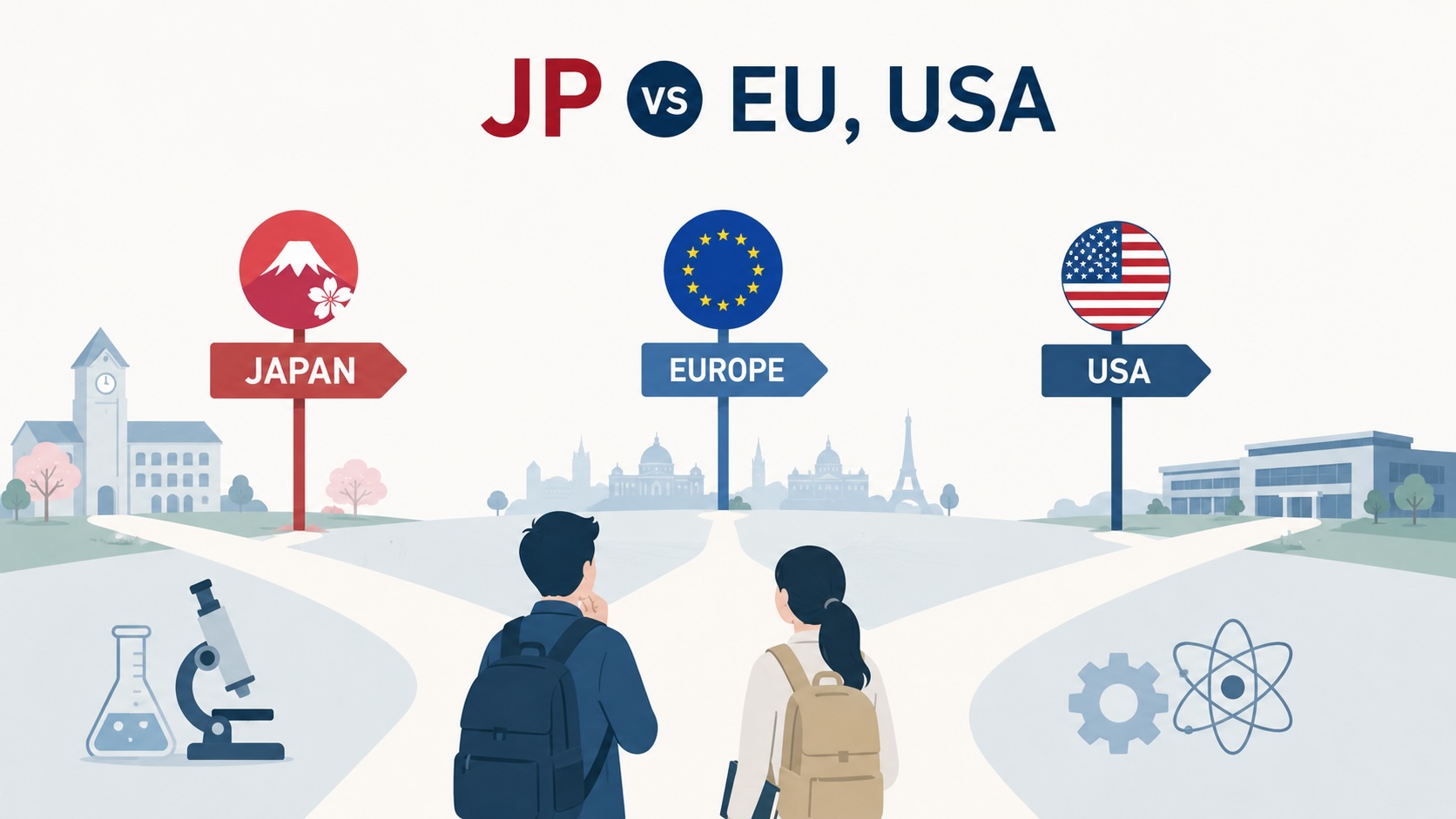
Japan vs. Europe and the United States
A simple ranking cannot capture every situation. The United States is not one environment, and Europe includes both very safe countries and cities with more visible crime problems. Still, as a broad comparison for students and professionals choosing a study or work destination, Japan is usually safer in the most practical daily-life sense.
| Point of comparison | Japan | Europe and the United States |
|---|---|---|
| Violent crime | Very low by large-country standards. | The United States is much higher. Many European countries are safe, but levels vary widely by country and city. |
| Gun violence | Extremely limited in ordinary civilian life. | A major concern in the United States; generally less severe in Europe but still country-dependent. |
| Public transport | Usually clean, reliable, and safe even for daily commuting. | Often good in Europe, but safety and cleanliness vary by city. In many US cities, car dependence changes the safety picture. |
| Student life | Campus routines, train commuting, convenience stores, and quiet residential areas make daily life manageable. | Strong universities, but the surrounding environment can differ greatly between campuses and cities. |
| Main risks | Natural disasters, heat, language barriers, scams, harassment, and isolation. | Country-specific. In some places, violent crime, theft, drugs, public disorder, or healthcare costs may be more serious concerns. |
In other words, Japan is not only “safe because crime is low.” It is safe because many parts of daily life are designed around order, public transport, routine, and social predictability. This is one reason Japan can be a very good option for people who want to concentrate on science, engineering, research, or professional development.
How safe is Japan in numbers?
One useful indicator is intentional homicide. It is not the only measure of safety, but it is a strong indicator of severe violence. World Bank data based on UNODC sources report Japan’s intentional homicide rate in 2023 at about 0.23 per 100,000 people. The corresponding value for the United States is about 6 per 100,000 people. This means the US rate is roughly more than twenty times higher by this indicator.
Europe is generally much safer than the United States, but Japan is still exceptionally safe within the group of large developed countries. Eurostat reported 3,930 intentional homicides in the EU in 2023, while Japan’s population-adjusted homicide rate remains among the lowest internationally. The practical message is simple: if serious violent crime is a major concern, Japan is one of the strongest choices.
The Global Peace Index also consistently places Japan among the more peaceful countries in the world, while the United States ranks much lower. These indices should not be read mechanically, because they include many indicators beyond student life. Nevertheless, they support what many residents experience directly: Japan provides a highly stable daily environment.
Low petty crime in everyday scenes
Japan’s safety is easy to understand in ordinary daily scenes. Pickpocketing, bag snatching, street fights, and aggressive public trouble are relatively uncommon in the places where students and professionals usually spend time: stations, trains, campuses, laboratories, supermarkets, convenience stores, and residential streets.
In most university towns and major residential areas, it is generally fine to walk at night, return home after late laboratory work, or buy food at a convenience store in the evening. You should still keep your passport, residence card, wallet, phone, and laptop under control, but daily life does not usually require the same constant street-level caution that newcomers may need in some large cities in Europe or the United States.
Public transport also feels practical because it is used by everyone: students, office workers, families, children, and elderly people. If you avoid disturbing others, follow basic manners, and stay aware of your belongings, commuting is usually something you can do calmly rather than defensively.
Practical advice for international students
For international students, the most useful point is simple: you can usually build a normal routine without making safety the center of every decision. It is generally acceptable to commute by train, study in the library, leave campus after seminars or experiments, shop at a convenience store at night, and walk back to your apartment in ordinary residential areas.
If you are lost, confused by a train transfer, unable to find an address, or unsure what to do, it is usually safe to ask for help. Police boxes, station staff, university offices, shop staff, and nearby people are normal sources of assistance. Even when English is limited, showing a map, address, residence card, or university name on your phone often works.
The practical advice is not to become careless, but to relax within normal manners. Keep valuables with you, avoid excessive drinking in unfamiliar areas, do not follow strangers into suspicious shops or bars, and learn your route home. If you do these basic things, everyday student life in Japan is usually very manageable.
This is one reason Japan should not be dismissed simply because some universities rank below famous US or European institutions. For many students, the best choice is not only the university name, but the combination of research opportunity, supervision, funding, living cost, and daily safety.
Practical advice for professionals and researchers
For professionals, postdocs, visiting researchers, and engineers, Japan’s safety is most valuable in repeated daily routines. During commuting, you normally do not need to be tense if you are simply standing in line, waiting on the platform, riding a train, or walking through a station. As long as you do not block others, speak loudly in quiet spaces, or ignore local manners, you are unlikely to be pulled into trouble.
This matters for people who work long hours, attend evening meetings, visit collaborators, or move with family members. A predictable commute and low level of visible street conflict make it easier to focus on work, research, childcare, housing, and settling into a new environment.
The practical advice is to use this stability well. Choose housing with a simple route to campus or workplace, learn the nearest station, police box, clinic, and convenience store, and save your institution’s emergency contact. If you feel unsure, ask early rather than trying to solve everything alone.
Japan is not always the best country for salary, career mobility, or English-language convenience. But if personal safety, family stability, and low-stress commuting are major priorities, Japan is a very strong candidate.
Japan-specific risk 1: disasters and climate
The most important Japan-specific safety issue is natural disaster risk. Japan has earthquakes, typhoons, heavy rain, flooding, landslides, volcanic areas, and tsunami risk in some coastal regions. These risks are real, and students should not ignore them simply because everyday crime is low.
The positive side is that Japan has strong disaster-preparedness systems: earthquake-resistant buildings, public warnings, local hazard maps, evacuation shelters, school and workplace drills, and detailed municipal information. The system is generally good, but it works best when residents know how to use it.
Summer heat is another serious issue. Japan’s hot and humid summers can be difficult for newcomers, especially those commuting, cycling, doing fieldwork, wearing formal clothing, or living in older apartments. Heat illness can become a medical emergency. Students should treat air conditioning, hydration, and heat-warning information as practical safety tools, not luxuries.
Japan-specific risk 2: scams, harassment, healthcare, and language barriers
Japan’s low violent-crime environment can sometimes make newcomers too relaxed. More realistic problems include bicycle theft, online scams, suspicious part-time job offers, investment or romance scams, contract trouble, stalking, groping on crowded trains, hidden cameras, and harassment. These issues are not unique to Japan, but they do exist.
Healthcare and emergency communication can also be difficult. Japan has a well-developed healthcare system, but not every clinic can communicate in English. Some hospitals require specific procedures, referral letters, or advance phone calls. If you wait until you are sick to search for help, the system can feel confusing.
Language barriers matter most during stressful moments: illness, accidents, police reports, lost property, housing trouble, or city office procedures. Even if your university or company uses English, daily life outside campus may require basic Japanese. This is not a reason to avoid Japan, but it is a reason to prepare.
What to prepare in your first month
The best way to benefit from Japan’s safety is to build a simple safety routine early. You do not need to live with fear. You only need to know what to do before a problem occurs.
- Save emergency numbers: police 110, fire and ambulance 119, your university or workplace emergency contact, and your landlord or housing office.
- Register your address and complete health insurance procedures at the city or ward office.
- Find the nearest clinic, hospital, pharmacy, police box, supermarket, station, and evacuation site.
- Check your local hazard map for flooding, landslide, tsunami, or earthquake-related risks.
- Prepare water, simple food, a flashlight, mobile battery, basic medicine, and copies of key documents.
- Learn basic Japanese phrases for illness, emergency, lost property, police, ambulance, and address explanation.
- Be careful with unknown job offers, money-transfer requests, and anyone asking for your bank account or residence card image.
Practical conclusion
Japan is genuinely one of the safest major destinations for international students and professionals. Compared with the United States and many European alternatives, its advantage is clear in low violent crime, low visible petty crime, fewer street fights, orderly public transport, and predictable daily routines. In practical terms, newcomers can usually commute, shop at night, ask for help, and move between campus, work, home, and public services with much less anxiety than in many other countries. A fair guide should still mention Japan-specific risks, especially disasters, summer heat, scams, harassment, healthcare access, and language barriers.
Useful official sources
- World Bank: Intentional homicides per 100,000 people, Japan and United States
- Eurostat: Intentional homicides recorded in the EU in 2023
- Institute for Economics & Peace: Global Peace Index
- JNTO: Japan Visitor Hotline and useful phone numbers
- JNTO: Safety tips for travelers in Japan
- Study in Japan: National Health Insurance
- Ministry of the Environment: Heat Illness Prevention Information
Read next