Tokyo vs. Regional Universities in Japan: Living as an International Student
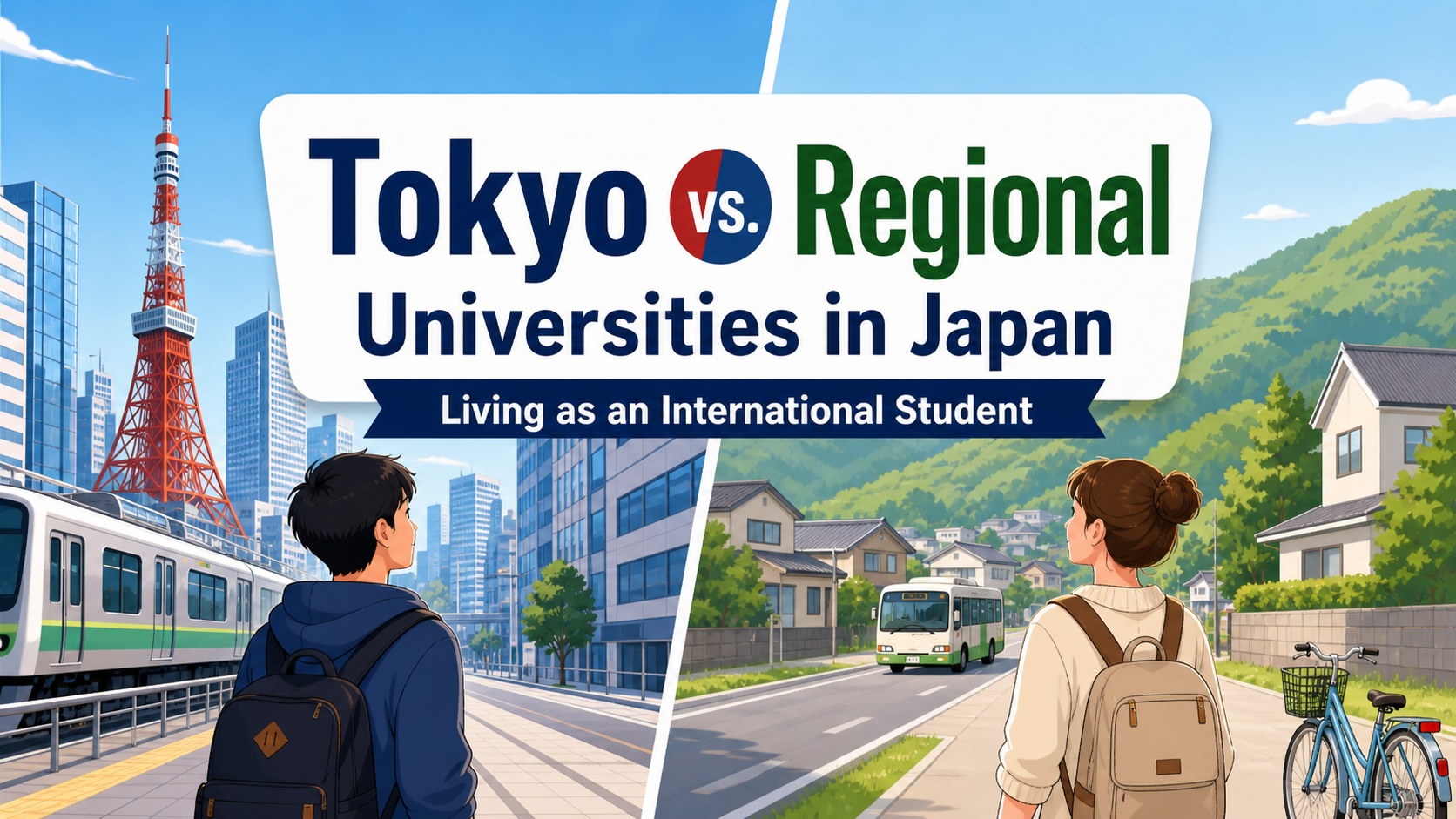
Many international students first imagine studying in Tokyo. This is understandable: Tokyo is famous, global, convenient, and easier to recognize from outside Japan. However, one of Japan’s major strengths is that many regional cities with major universities are also safe, clean, organized, and highly functional for daily life. If your university and laboratory are strong, you do not need to be tied to Tokyo just because you are worried about living in Japan.
Quick summary
- Tokyo offers the highest density of English-speaking services, international communities, events, companies, and specialized daily-life options.
- However, major regional university cities in Japan are often fully functional for international student life.
- Regional cities can offer lower rent, shorter commuting, calmer routines, easier access to campus, and less financial pressure.
- For graduate students, especially those who spend most of their time in a laboratory, a strong regional university can be as good as, or better than, a Tokyo option.
- The key is not “Tokyo or countryside.” The key is whether the city, university, laboratory, and support system together create a stable life.
The main message: do not overestimate the need to live in Tokyo
From outside Japan, Tokyo can look like the safest choice. It is internationally known, full of companies, and easier to imagine. However, for student life, Tokyo is not always necessary. Many Japanese regional university cities have supermarkets, hospitals, public transportation, student housing, restaurants, cafés, mobile phone shops, city offices, libraries, gyms, and international student offices within a manageable distance from campus.
This is a major advantage of Japan as a study destination. In some countries, leaving the largest city may mean giving up important infrastructure. In Japan, this is often not the case. Regional cities may be smaller, but they are frequently clean, safe, predictable, and convenient enough for a stable student life. For many international students, especially graduate students, this practical stability can matter more than the global name of the city.
The best question is therefore not “Is Tokyo better?” A better question is: “Can I live comfortably enough near this university while focusing on my studies or research?” If the answer is yes, a regional university should be taken seriously.
Why regional university cities can work very well
Major regional universities are usually located in cities that already support large student populations. These cities are not remote villages. They often have a complete ecosystem around the university: apartments, dormitories, bicycle routes, buses, clinics, supermarkets, convenience stores, part-time job options, and local communities used to students moving in and out every year.
This makes daily life surprisingly manageable. A student may be able to live near campus, walk or cycle to the laboratory, buy daily goods nearby, and build a routine quickly. In graduate school, this can be a significant advantage. If you are spending long hours in experiments, seminars, coding, writing, or fieldwork, saving one hour of commuting every day may be more valuable than living in a famous metropolitan area.
Regional cities can also make Japan feel more understandable. In Tokyo, the city is huge and fragmented. In a regional university city, your campus, apartment, supermarket, clinic, station, and favorite café may all become part of one clear daily map. For international students living abroad for the first time, that simplicity can reduce stress.
Cost and commuting: regional cities often give you more breathing room
Housing is one of the strongest reasons not to focus only on Tokyo. The Study in Japan official website, based on JASSO’s 2023 Lifestyle Survey of Privately Financed International Students, lists the national average monthly rent for international students as 41,000 yen, while Tokyo is 57,000 yen. The same official site notes that rents in Tokyo and other large cities are higher than in more rural areas, and that students in metropolitan areas may also face longer commuting distances.
This difference is not only about money. A lower rent can reduce the need for part-time work. Living near campus can reduce commuting fatigue. A larger room can make studying, sleeping, cooking, and calling family easier. These small factors strongly affect academic performance and mental health over several years.
For scholarship students, regional life can make the scholarship feel more sufficient. For privately funded students, it can make the entire study plan more realistic. Tokyo may offer more opportunities, but it can also consume time and money before those opportunities become useful.
What Tokyo is still very good at
Tokyo remains the strongest choice for certain needs. It has more English-speaking clinics, international grocery stores, embassies, cultural and religious communities, multilingual support services, career events, internships, startups, and corporate offices. If you have very limited Japanese ability and need many services in English from the beginning, Tokyo can reduce daily-life friction.
Tokyo is also useful for students who are already thinking about corporate careers, internships, networking, or international events. If your field is closely connected to companies, finance, consulting, policy, media, startups, or global business, the Tokyo area may offer more face-to-face opportunities than most regional cities.
However, these advantages should be weighed against cost and routine. Many graduate students do not attend events every week. They spend most of their time on campus, in the laboratory, or at home. If your daily life is built around research, a calm and affordable regional city may serve you better than a crowded and expensive metropolis.
English support: check the university, not only the city
It is true that Tokyo has more English-speaking services outside the university. But student life is not supported by the city alone. In many cases, the university’s international office, graduate school office, dormitory staff, laboratory members, and supervisor are more important than the number of English signs in the city center.
Some regional universities have strong international student offices, English-taught graduate programs, Japanese language classes, dormitory support, tutor systems, and staff who are used to helping foreign students. Conversely, some large-city universities may still expect students to handle many procedures by themselves. Therefore, do not judge English support only by whether the university is in Tokyo.
The practical question is simple: when you face a problem, who will help you? If the university has a reliable support system, a regional city can be very comfortable. If the university has weak support and you have no Japanese ability, even a convenient city can become stressful.
Japanese ability still matters, but Tokyo is not the only solution
Japanese ability improves life everywhere in Japan. It helps with housing, hospitals, city hall, banks, part-time work, friendships, laboratory communication, and emergencies. In regional cities, Japanese ability may matter more because fewer services are available in English. This is an important point and should not be ignored.
However, this does not mean that students with imperfect Japanese must choose Tokyo. Many international students successfully live in regional Japan by combining university support, translation tools, basic Japanese study, help from laboratory members, and gradual adaptation. The first months may require effort, but the environment can become comfortable once a routine is established.
A realistic target is not perfect Japanese. It is functional Japanese: being able to greet people, read basic notices, explain simple symptoms at a clinic, understand garbage rules, ask for help at a station, and communicate politely with administrative staff. If you are willing to improve this level, regional life becomes much more accessible.
Student life may be easier when the city is smaller
A smaller city can make student life more concentrated. You may meet the same students repeatedly on campus, in the dormitory, at the supermarket, or around the station. This can make it easier to form relationships, especially if the university has an active international student community.
Tokyo has many communities, but it can also be anonymous. People are spread across a huge metropolitan area, commuting takes time, and social groups may be difficult to find unless you actively search for them. In a regional university city, the number of options may be smaller, but the connection between university and daily life can be stronger.
For research students, master’s students, and doctoral students, this matters. A good laboratory community in a regional city can provide more practical support than simply living in a famous city. The people around you may shape your life more than the city name itself.
When you should still prioritize Tokyo or another large city
The point is not that regional universities are always better. Tokyo, Yokohama, Osaka, Kyoto, Nagoya, Fukuoka, and other large cities may be better if your life requires frequent access to English-speaking doctors, embassies, religious facilities, international schools for family members, corporate offices, specialized food, or field-specific networking events.
Large cities may also be preferable if your Japanese ability is very limited and your university does not offer strong support. In that case, the surrounding city becomes a safety net. More English-speaking services can reduce the risk that a small daily problem becomes a major obstacle.
In other words, Tokyo is valuable when you actually need Tokyo-specific functions. But if you mainly need a good laboratory, affordable housing, stable daily life, and enough support to handle procedures, a regional university city may already provide what you need.
How to check whether a regional university city is enough for you
Before choosing a university, look beyond rankings and campus photos. Check the practical living environment around the campus. Search for the nearest station, supermarket, clinic, hospital, dormitory, bus route, bicycle access, international office, language classes, and student communities. Also check whether the campus is in the city center, near a station, or in a suburban area that requires a bicycle or bus.
Ask current students if possible. University websites often show formal information, but current students can tell you whether daily life is easy, whether English support really works, whether apartments are available near campus, and whether international students feel included.
For graduate students, also ask laboratory-specific questions: Are there other international students in the lab? Do members help with first-month procedures? Are seminars in English or Japanese? Can you communicate with the supervisor comfortably? A supportive laboratory can make regional life much easier.
Practical conclusion
International students do not need to treat Tokyo as the default answer. Japan’s major regional university cities are often safe, functional, affordable, and comfortable enough for serious study. Tokyo is excellent when you need its density, English services, and career network. But if your priority is research, stable daily life, and lower financial pressure, a strong regional university can be a very smart choice.
Checklist before deciding that you “need” Tokyo
- Check whether the university has an international student office that actively supports daily procedures.
- Look at rent near the actual campus, not only the general reputation of the city.
- Estimate commuting time from realistic housing options to the laboratory or classroom.
- Search for supermarkets, clinics, hospitals, banks, mobile phone shops, and city hall access near campus.
- Check whether there are dormitories or housing support systems for international students.
- Ask whether other international students live comfortably in the department or laboratory.
- Consider whether you need Tokyo-specific services every week, or only occasionally.
- Be honest about your Japanese level, but do not assume that imperfect Japanese makes regional life impossible.
Useful official sources
- Study in Japan: Living Costs and Expenses
- Study in Japan: Accommodation
- Study in Japan Official Website
- JASSO: Study in Japan
Read next