How to Choose a Japanese University for Science and Engineering: Rankings vs. Labs
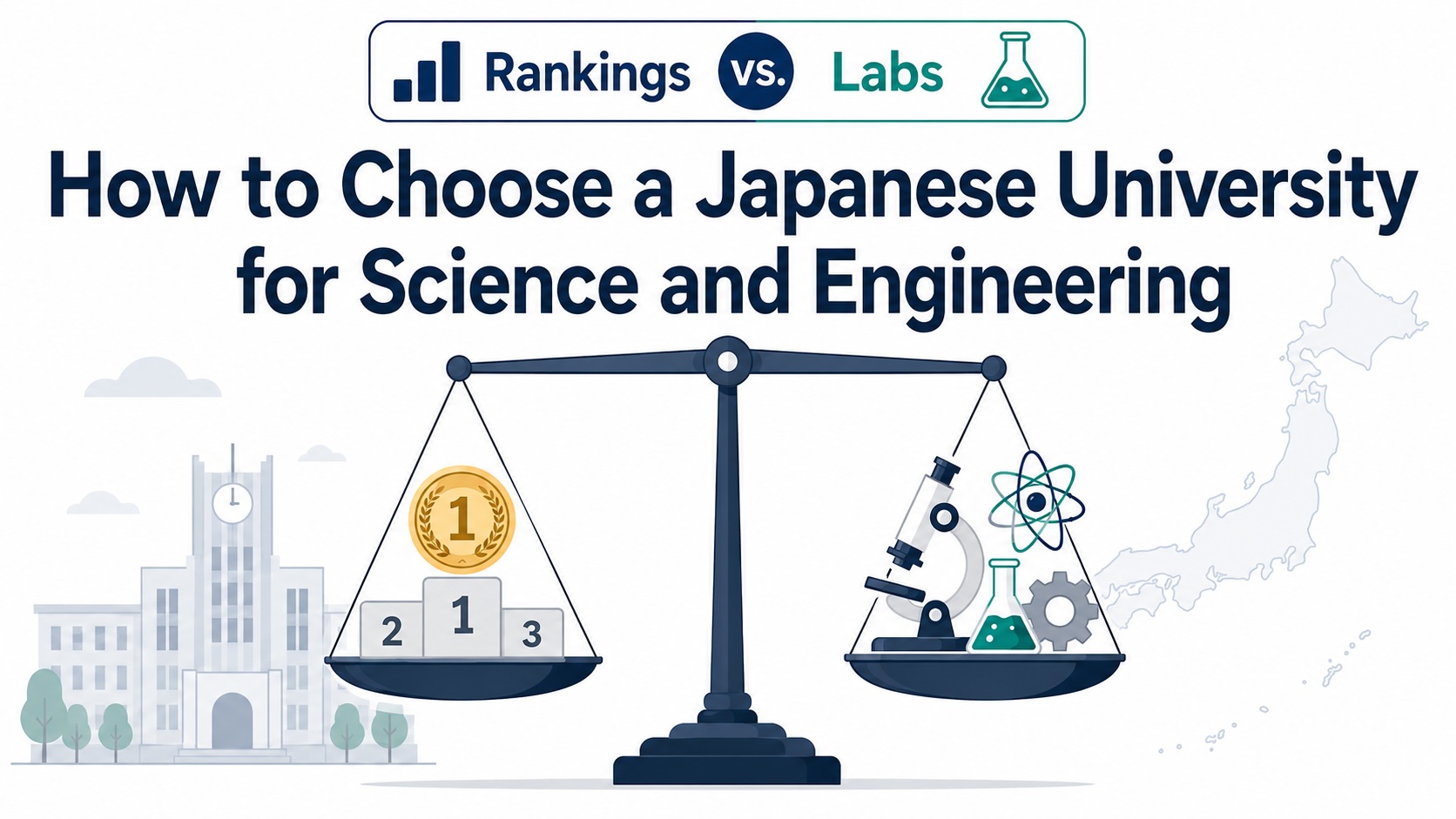
When international students choose a Japanese university, rankings are often the first thing they check. Rankings are useful because they show broad reputation and international visibility. However, for science and engineering students, the final decision should usually be made at the laboratory level. The most important question is not only “Which university is famous?” but also “Which laboratory can train me in the research field I actually want to enter?”
Quick summary
- University rankings are useful for making an initial shortlist.
- For graduate research, laboratory fit often matters more than overall university rank.
- Start from your research theme, then search across several strong Japanese universities.
- Recent publications and an updated lab website are simple signs of activity.
- A practical goal is to reduce a long list to about 3–5 laboratories before contacting professors.
Use rankings as a starting point, not the final answer
Rankings can help you identify universities with strong overall visibility. This is especially useful if you are unfamiliar with Japan and need a first map of major research universities. Rankings may also matter when you apply for scholarships, explain your degree abroad, or move to another country after graduation.
At the same time, rankings are institution-level signals. They do not tell you whether a specific professor is active, whether a laboratory has the instruments you need, whether students are publishing, or whether your proposed research topic is realistic there. For science and engineering, these lab-level questions are often more important than the university’s overall position in a global table.
A simple way to think about it
Rankings are useful for the first filter. Laboratory evidence should be used for the final decision. For research-based master’s and doctoral study, “best university” and “best lab for me” are not always the same answer.
Why labs matter so much in science and engineering
In many Japanese graduate schools, students join a laboratory and work under a specific supervisor. The laboratory is where daily research life happens: experiments, seminars, technical training, paper discussions, safety training, collaborations, and career advice. This is particularly important in fields such as chemistry, physics, materials science, biotechnology, mechanical engineering, electrical engineering, and related areas.
A strong lab can exist at a university that is not globally famous. Conversely, a highly ranked university may have only one or two laboratories related to your specific theme, and those labs may not be the best fit for your project. This is why students should look beyond the university name and examine the actual research group.
A realistic process: from research theme to 3–5 candidate labs
A practical search should begin with your research theme. Do not start by asking only “Which university is ranked highest?” Instead, define the field or subfield you want to study. For example, “materials chemistry” is still broad. A more useful starting point might be “organic semiconductors,” “photocatalysis,” “soft robotics,” “quantum materials,” or “polymer membranes.”
Once you narrow the theme to the field level, you will usually find that even a major university has only a few relevant laboratories. In many cases, a single university will have only two or three labs that are close to your topic. This is not unique to Japan. It is generally true at universities around the world because modern science and engineering are highly specialized.
The next step is to repeat this search across multiple universities. If you check roughly the top ten research-oriented Japanese universities in your area, often including major national universities, you may end up with around 20 possible laboratories. This is a more realistic long list than simply choosing one famous university and hoping that the right lab is there.
Some of those 20 labs will not be active candidates. The professor may have changed topics, the website may be old, the lab may not be accepting students, or recent papers may be limited. The easiest first indicators are the publication list and the lab website. Are there recent papers? Are current members shown? Does the group photo look recent, active, and well maintained? A bright and updated group photo is not scientific evidence by itself, but it often tells you whether the lab communicates its current activity to students.
After this screening, reduce the list to about three to five serious candidates. Then read their recent papers more carefully, check the graduate school admission route, look for possible funding or scholarship options, and prepare a focused email to the professor. This process is slower than choosing by ranking alone, but it is much safer for research-based graduate study.
What to check when comparing labs
You do not need to evaluate every detail at the beginning. Start with simple, visible evidence. If the lab still looks suitable after this first check, then investigate more deeply.
- Recent publications: Are there papers from the last three to five years in your target field?
- Research fit: Do the methods and topics match what you actually want to learn?
- Student activity: Do students appear as authors, presenters, or current lab members?
- Funding signals: Are there recent KAKEN, JST, NEDO, AMED, university, or industry projects?
- Facilities: Does the lab or department have realistic access to the instruments you need?
- International suitability: Is there evidence that international students can work in the lab?
Funding should be interpreted carefully. A research grant may support experiments, instruments, travel, or project staff, but it does not always mean that the lab can directly pay your tuition or living expenses. Still, active research funding is often a good sign that the lab is running current projects.
Red flags when checking a laboratory
A lab does not need to be famous to be good. However, some warning signs suggest that you should ask more questions before applying.
- The lab website has not been updated for several years.
- Recent publications are very limited or unrelated to your proposed topic.
- The professor’s current affiliation, position, or retirement timing is unclear.
- The lab lists many research themes, but recent papers show only one narrow activity.
- No information is available about students, facilities, seminars, or current projects.
- The professor’s reply is positive but vague about whether they can supervise your topic.
When rankings matter and when labs matter
Rankings may deserve more weight if you are applying for an undergraduate program, a coursework-heavy master’s program, a scholarship where institutional reputation is important, or a career path where the university name will be highly visible. They can also help when you want a degree that is easily recognized outside Japan.
Lab strength deserves more weight when your main goal is research training. Your thesis topic, technical skills, publications, recommendation letters, and daily supervision will be shaped by the laboratory. In specialized fields, a lower-ranked university with a highly active lab can be a better choice than a famous university with a poor research fit.
How this changes your email to a professor
Once you evaluate the lab carefully, your email becomes much stronger. Instead of writing only “I want to study at your university because it is highly ranked,” you can explain why the professor’s recent research fits your background and goals.
A better message might mention one or two recent papers, the technique or topic you want to learn, your previous research experience, and the degree program or scholarship route you are considering. This shows that you are not sending the same generic email to every famous university.
Before you decide, ask yourself
- Am I choosing this university because of its name, or because a specific lab fits my research goals?
- Can I identify at least three recent papers from the lab that are relevant to my interests?
- Does the lab have the equipment, methods, and collaborations needed for my project?
- Is the professor currently active and likely to accept new students?
- Do I understand the admission route and possible funding route?
Final advice
For science and engineering students, rankings should be treated as a map, not as the destination. They help you understand the landscape of Japanese universities, but they cannot replace careful lab-level research. Start with your research theme, search across several universities, identify active labs, and reduce your list to a few serious candidates.
Japan has many strong research groups in chemistry, physics, materials science, engineering, and related fields. Some are in globally famous universities. Others are better known within specific research communities. If you choose carefully, a Japanese laboratory can be an excellent place to build technical skills, publish research, and prepare for a scientific or engineering career.
Important note
Rankings, research outputs, funding, faculty positions, admission rules, language requirements, scholarship options, and laboratory availability change over time. This article provides general guidance only. Always confirm the latest information through official university pages, graduate school offices, professor profiles, and public research databases.
Useful official sources
The following sources can help you compare university-level reputation with lab-level research evidence.
- QS World University Rankings: Methodology
- Times Higher Education World University Rankings: Methodology
- KAKEN: Database of Grants-in-Aid for Scientific Research
- researchmap
- Study in Japan: Search for schools
- Your target university’s graduate school admissions page
- Your target laboratory or professor’s official website
Read next