
How to Contact a Japanese Professor Before Applying
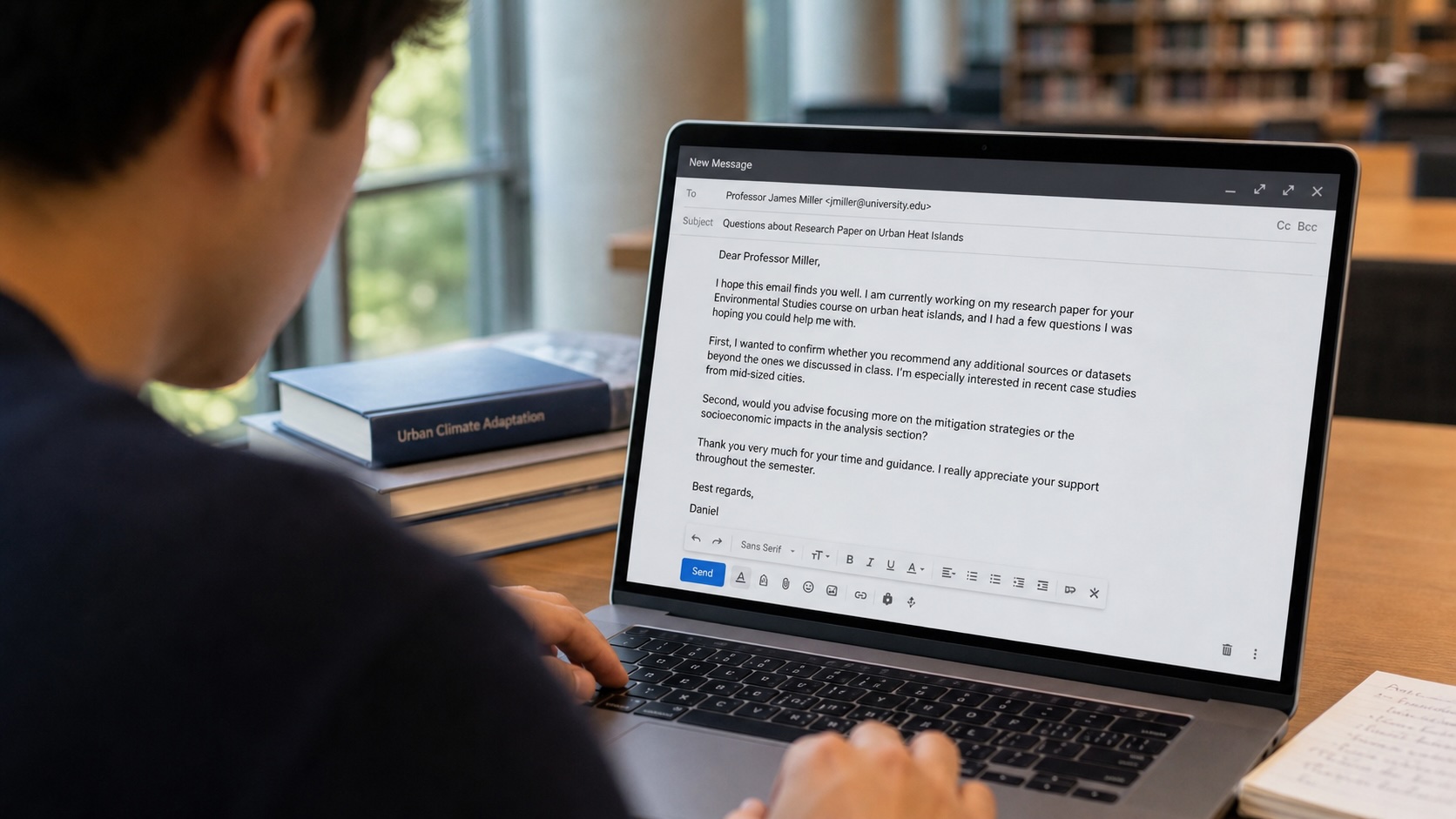
Contacting a professor before applying is common in many Japanese graduate schools, research programs, and scholarship pathways. A good first email does not need to be long. It should show that you understand the professor’s research, explain your own background clearly, and make it easy for the professor to decide whether your interests may fit the laboratory.
Quick summary
- Write a short, specific, and respectful email.
- Show that you have read the professor’s recent work or laboratory website.
- Attach a concise CV and, when relevant, a short research proposal.
- Do not send the same generic email to many professors.
- If there is no reply, one polite follow-up after about one to two weeks is usually enough.
Why contacting a professor matters
In Japan, admission procedures vary depending on the university, graduate school, department, program, and scholarship route. In some cases, formal application is possible without contacting a professor first. In other cases, finding a potential supervisor before applying is practically important.
Even when it is not formally required, contacting a professor can help both sides evaluate whether your academic background, research interests, language ability, timing, and funding plan are realistic for the laboratory.
The goal of the first email is not to ask for immediate acceptance. The goal is to start a professional conversation and make it easy for the professor to understand who you are.
Before writing the email
Before sending an email, spend enough time checking the professor’s laboratory website, recent papers, university profile, and graduate school information. A professor can usually tell whether an inquiry is based on genuine interest or simply copied and sent to many laboratories.
You should also check whether the university or department gives specific instructions for contacting faculty members. Some programs ask applicants to contact a supervisor in advance, while others ask applicants not to contact individual professors before completing a formal procedure.
Information to prepare
- Your current university, degree program, and expected graduation date.
- Your research field, thesis topic, or major academic experience.
- Why the professor’s laboratory is relevant to your interests.
- Your intended program, such as master’s, doctoral, research student, or postdoctoral route.
- Your expected application period and possible funding source.
- A concise CV, preferably one or two pages for an initial inquiry.
What to include in the first email
A strong first email is usually simple. It should not be a long autobiography. It should provide enough information for the professor to understand your background and decide whether a short reply or meeting would be worthwhile.
| Part | Purpose | Practical advice |
|---|---|---|
| Subject line | Show the purpose immediately. | Include your intended program and research area. |
| Opening | Introduce yourself briefly. | State your name, university, degree level, and field. |
| Research fit | Explain why you are contacting this professor. | Mention a specific research topic, paper, or lab direction. |
| Your background | Show that you may be a realistic candidate. | Summarize your thesis, skills, or relevant experience. |
| Request | Make the next step clear. | Ask whether the professor may be open to reviewing your materials or discussing fit. |
| Attachments | Provide enough information without overloading the email. | Attach a CV and, if appropriate, a short research proposal. |
A sample email template
The template below is intentionally simple. You should customize it carefully for each professor and each laboratory.
Subject: Prospective Master’s Student Interested in [Research Topic]
Dear Professor [Family Name],
My name is [Your Name], and I am currently a [final-year undergraduate / master’s student] at [University Name] in [Country]. I am writing to ask whether you may be open to considering prospective students in your laboratory for [Master’s / Doctoral / Research Student] admission in [Month/Year].
I am interested in your research on [specific topic]. In particular, I read your work on [paper, project, or research direction], and I found it closely related to my current interest in [your research interest].
My current research focuses on [brief description of your research background]. Through this work, I have experience in [methods, techniques, analysis, programming, experiments, or fieldwork]. I would like to further develop this background in the context of [future research direction].
I have attached my CV and a brief summary of my research interests for your reference. If my background may fit your laboratory, I would be grateful for the opportunity to ask whether applying to your program would be appropriate.
Thank you very much for your time and consideration.
Sincerely,
[Your Name]
Tone and style
A professor is not only evaluating your academic ability. They are also checking whether communication with you seems clear, realistic, and respectful. The tone should be polite, but not overly dramatic.
Avoid phrases that put too much pressure on the professor, such as “Please accept me,” “I desperately need your help,” or “I want a scholarship from your laboratory.” It is better to frame the email as an inquiry about research fit and application feasibility.
Good tone
- Specific: “I am interested in your recent work on...”
- Respectful: “I would be grateful if you could let me know whether...”
- Realistic: “I understand that admission depends on the formal selection process.”
- Concise: “I have attached my CV for your reference.”
Tone to avoid
- Overly generic emails that could be sent to any professor.
- Very long emails with too many personal details.
- Strong demands for acceptance, funding, or immediate meetings.
- Emails that show no understanding of the professor’s research field.
What to attach
Attachments should help the professor understand your background quickly. They should not make the email difficult to read.
- CV: Include education, research experience, publications if any, skills, awards, and contact information.
- Research summary: One page is often enough for an initial inquiry.
- Transcript: Attach only if requested or clearly useful for the program.
- Portfolio or GitHub: Useful for fields involving programming, design, data analysis, or engineering projects.
Use clear file names, such as YourName_CV.pdf or YourName_ResearchSummary.pdf. Avoid sending large files unless necessary.
When and how to follow up
Professors often receive many emails and may be traveling, teaching, reviewing papers, writing grants, or managing students. If you do not receive a reply, it does not always mean that your email was rejected.
A polite follow-up after about one to two weeks is usually reasonable. The follow-up should be short and should not sound impatient.
Subject: Follow-up: Prospective Student Inquiry on [Research Topic]
Dear Professor [Family Name],
I hope this message finds you well. I am writing to briefly follow up on my previous email regarding possible graduate study in your laboratory.
I understand that you may be very busy, but I would be grateful if you could let me know whether my background may be relevant to your laboratory or whether there is a more appropriate application procedure I should follow.
Thank you again for your time.
Sincerely,
[Your Name]
If there is still no reply after one follow-up, it is usually better to move on or contact another suitable professor. Repeated emails may create a negative impression.
Common mistakes
- Sending a generic email: Professors can easily recognize copied messages.
- Writing too much: A first email should be informative but not overwhelming.
- Not checking the professor’s field: A broad match is not enough; research fit matters.
- Asking for funding too early: It is better to first establish academic fit and application route.
- Ignoring official procedures: A professor’s positive reply does not replace formal admission requirements.
- Using unclear attachments: Files should be short, readable, and clearly named.
Important note
A reply from a professor does not guarantee admission, funding, visa approval, or formal acceptance. Japanese universities usually have official application procedures, deadlines, examinations, document screening, or scholarship selection processes. Always check the official instructions of the university, graduate school, and program.
Final checklist before sending
- Did you use the professor’s correct name and title?
- Did you mention a specific research topic from the professor’s lab?
- Did you clearly state your current degree level and intended program?
- Did you explain your research background in a few sentences?
- Did you attach a concise CV?
- Did you avoid making demands for acceptance or funding?
- Did you check the official application instructions?
Useful sources to check
Before and after contacting a professor, check the official sources related to your target university and program. Useful sources usually include:
- The professor’s laboratory website
- The department or graduate school admissions page
- The university’s international admissions page
- Scholarship program guidelines, if applicable
- Official application forms and deadlines