Campus Life Around Osaka University: Student Life Across Toyonaka, Suita, and Minoh
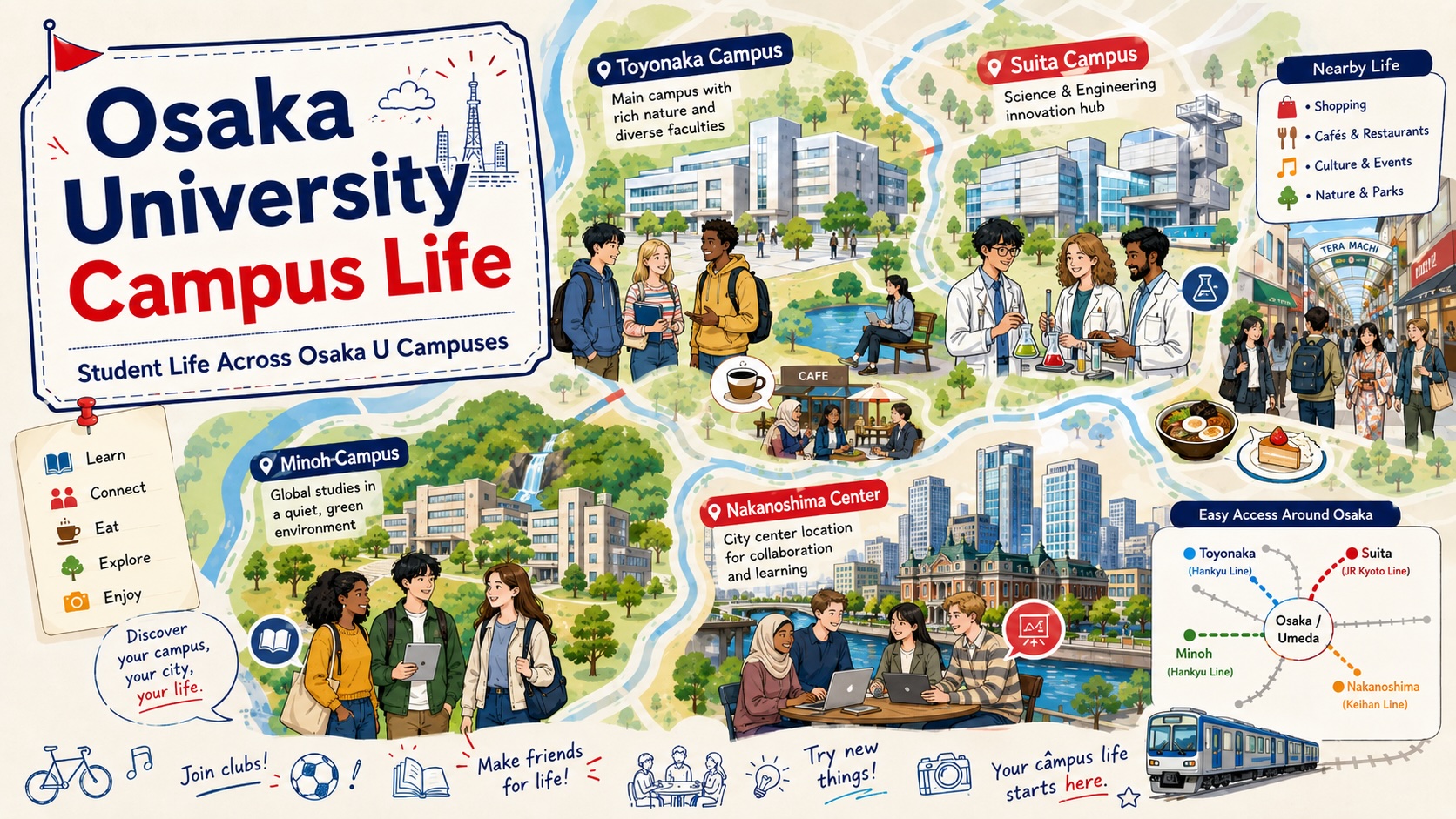
Osaka University is not a one-campus experience. Student life can mean Toyonaka, Suita, Minoh, or movement between them. For international students, the Kansai region is lively and convenient, but the first practical step is understanding which campus shapes your week.
Quick summary
- Osaka University has major student life across Toyonaka, Suita, and Minoh.
- The university provides student centers on the three campuses.
- A free shuttle bus exists between campuses, but official guidance notes it is not for commuting.
- International student residences and dormitories are available, but eligibility and availability must be confirmed.
- Kansai offers strong city life, but campus-specific commuting still matters.
This is an independent campus-life guide
This article is written for international students, graduate applicants, researchers, and professionals who want to understand daily life around Osaka University. It is not an official university page, and it does not rank universities or campuses. The goal is to explain what student life may feel like around the campus area and what practical points to check before moving to Japan.
Campus locations, dormitory availability, student support systems, transportation routes, and local prices can change. As of May 2026, applicants should always confirm the latest information on official university pages and through the relevant graduate school, international office, or laboratory.
Three campuses, not one student town
Osaka University student life is distributed across Toyonaka, Suita, and Minoh. Each campus has a different atmosphere and practical role. Toyonaka is often associated with a more traditional student-campus feeling. Suita is large and connected to science, engineering, medicine, and research facilities. Minoh has its own international and language-oriented identity.
This means that students should not simply ask, “What is Osaka University like?” They should ask, “Which campus will I use, and how will I move between campus, housing, and the city?”
The answer changes the best place to live, the commute, the eating options, and the daily social environment.
Toyonaka: student atmosphere and access
Toyonaka can feel like a more classic student campus area. It is connected to northern Osaka neighborhoods and has a daily rhythm shaped by classes, student activities, and local restaurants.
For students who want campus life with access to the wider Kansai region, Toyonaka can be attractive. It is not the same as living in central Osaka, but central areas are reachable by train.
Housing around Toyonaka should be considered together with campus distance, station access, and whether you need to visit Suita or Minoh regularly.
Suita: large research campus and practical routines
Suita is important for many research-oriented students. It is large, facility-rich, and connected to laboratories, hospitals, science and engineering, and other major university functions.
The advantage is academic concentration. If your laboratory is in Suita, living with good access to Suita may make research life more sustainable. The disadvantage is that moving to other campuses or central city areas can require planning.
For graduate students, this matters more than tourist access. A laboratory schedule with experiments, meetings, or evening work makes a realistic commute essential.
Minoh and multi-campus movement
Minoh adds another dimension to Osaka University life. It is not simply an extension of Toyonaka or Suita. Students based there may have different classmates, facilities, and commuting patterns.
Osaka University provides student centers on Toyonaka, Suita, and Minoh campuses, which is useful because students need local access to support services. The university also notes a free shuttle bus between the three campuses, but this is for attending classes on other campuses and not for ordinary commuting.
This distinction is important. Do not plan your housing on the assumption that the shuttle bus can replace normal commuting.
Living in the Kansai region
One advantage of Osaka University is access to Kansai. Students can reach Osaka city, Kyoto, Kobe, Nara, and other areas for weekend trips, conferences, cultural events, or part-time networks.
Daily student life, however, is usually more local. Most students build routines around campus, station, supermarket, cafeteria, apartment, and laboratory. Kansai’s richness becomes a bonus rather than the center of every day.
Food culture is strong, and affordable eating options are common, but students should still budget realistically for rent, commuting, and initial setup costs.
Food, cafés, and nearby places to visit
Osaka University has cafeterias and shops on the Toyonaka, Suita, and Minoh campuses, so daily food depends on where your classes and laboratory are located. Toyonaka often feels more student-oriented, Suita is larger and more research-oriented, and Minoh has a different urban-campus rhythm.
For food outside campus, students can enjoy the broader Kansai food culture without needing to live in central Osaka. Casual restaurants, cafés, bakeries, and shopping areas are available near each campus, while Umeda, Namba, and other central areas are realistic for weekends. Near Suita, Expo ’70 Commemorative Park is a major green space and cultural spot; near Minoh, Minoh Falls is a classic local outing.
A practical approach is to choose one campus food routine for weekdays and one Kansai area to explore on weekends. Osaka University life becomes much easier when you understand the relationship between your campus, monorail or train access, and nearby food areas.
Who will enjoy Osaka University life?
Osaka University is a good fit for students who want a large research university in a lively region, but who are willing to think carefully about campus location.
The key is to plan by campus: Toyonaka, Suita, and Minoh each create a different student life. Once that is clear, Osaka can be an energetic and practical place to study in Japan.
Useful sources
- Student Centers, Osaka University
- Instruction Manual / Student Life, Osaka University
- Residences for International Students, Osaka University
- For International Students, Osaka University
- Campus Stores and Cafeterias, Osaka University
- Expo ’70 Commemorative Park
Read next