Japanese Company Interviews for Technical Positions: What Foreign Applicants Should Expect
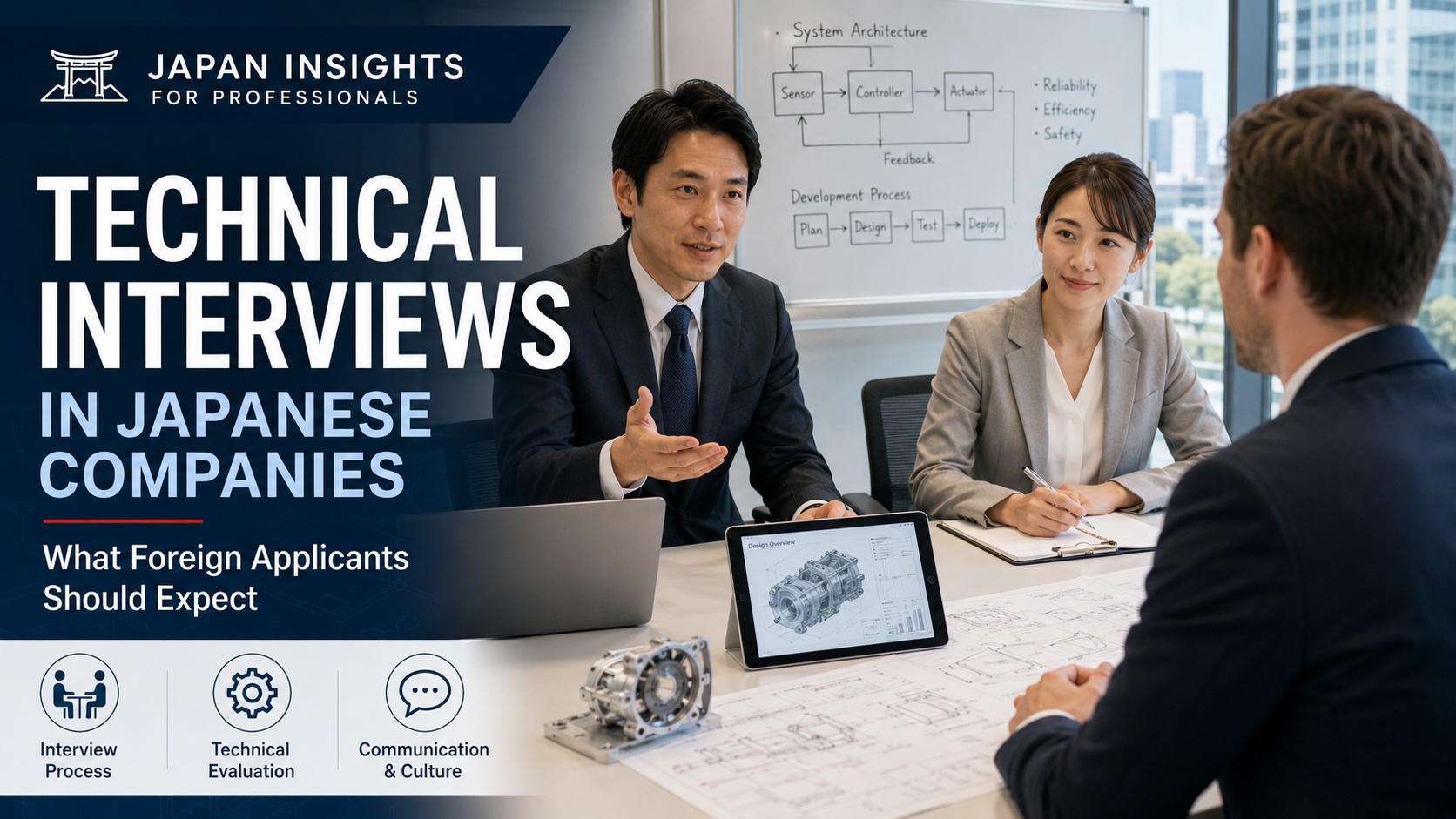
Technical interviews at Japanese companies can feel different from academic interviews or interviews in other countries. For R&D, engineering, data, manufacturing, or technical support positions, companies may ask about your research or skills, but they also want to know whether you can work in a team, explain complex topics clearly, learn company-specific methods, and adapt to Japanese workplace communication.
Quick summary
- A technical interview in Japan is rarely only a coding test or research presentation; it also checks communication, teamwork, and motivation.
- Applicants should prepare a simple explanation of their research, technical skills, failures, and role in projects.
- For R&D positions, companies often value whether your methods and thinking style can transfer to company problems.
- Japanese ability requirements vary widely, but the ability to communicate clearly and politely is important even in English-friendly teams.
- Prepare practical questions about role, training, team structure, evaluation, and expected language use.
What the company is trying to learn
In a technical interview, the company wants to know whether you can contribute to its work. That sounds obvious, but the meaning is broader than knowledge alone. Many Japanese companies train new employees internally, so they may care about your learning ability, communication style, reliability, and long-term motivation as much as your current technical topic.
For students and early-career researchers, the company may not expect you to have direct experience in its exact product area. Instead, interviewers may look for transferable thinking: how you define a problem, test hypotheses, analyze data, handle failure, explain results, and cooperate with others.
Common interview stages
The process differs by company, but technical applicants may face document screening, aptitude or web tests, HR interviews, technical interviews, manager interviews, and final interviews. Some companies ask for a research presentation. Others ask technical questions during a regular interview. For mid-career applicants, interviews may focus more directly on work experience and skills.
| Stage | What may happen | How to prepare |
|---|---|---|
| Document screening | CV, entry sheet, research summary, or portfolio review. | Make your skills and achievements understandable outside your narrow field. |
| HR interview | Motivation, communication, language ability, career plan. | Prepare why Japan, why this company, and why this role. |
| Technical interview | Research presentation, skill questions, problem-solving discussion. | Explain your methods, results, and personal contribution clearly. |
| Manager or final interview | Fit with team, long-term potential, work style. | Show that you understand company work, not only academic research. |
Technical questions you should expect
Technical questions often start from your own research or previous projects. Interviewers may ask why you chose a method, what was difficult, what failed, what you personally did, and how you would improve the project. Be ready to explain both the big picture and technical details.
- What was the goal of your research or project?
- What was your personal contribution?
- Which instruments, programming languages, software, or methods did you use?
- What was the most difficult technical problem?
- How did you handle failure or unexpected data?
- How can your experience be useful in our company?
- Can you explain your work to non-specialists?
The last question is important. In a company, you may need to explain technical topics to managers, sales teams, production teams, customers, and colleagues from different fields. A brilliant but overly narrow explanation may not be enough.
Communication, language, and workplace fit
Japanese ability requirements vary widely. Some R&D teams use English for research discussions, while others use Japanese in meetings, safety training, documents, and daily communication. Even when the interview is in English, the company may ask about your willingness to learn Japanese.
Communication style also matters. Japanese interviews often value calm, structured answers. You do not need to exaggerate achievements. It is usually better to explain what you did, what the team did, what you learned, and how you would apply that experience. If you do not know something, say so honestly and explain how you would approach the problem.
Questions foreign applicants should ask
Useful questions during a technical interview
- What kinds of projects would this position work on during the first year?
- How is technical training provided for new employees or foreign hires?
- How much Japanese is needed for meetings, reports, safety training, and daily work?
- How are R&D teams organized between research, product development, manufacturing, and business divisions?
- What skills would make a new employee successful in this role?
These questions show that you are thinking about the actual job, not only the company name. They also help you avoid mismatch. A role that sounds like “research” may include product testing, customer support, quality control, manufacturing transfer, or regulatory documentation depending on the company.
Useful sources
Read next