Japanese Business Emails for Technical Professionals
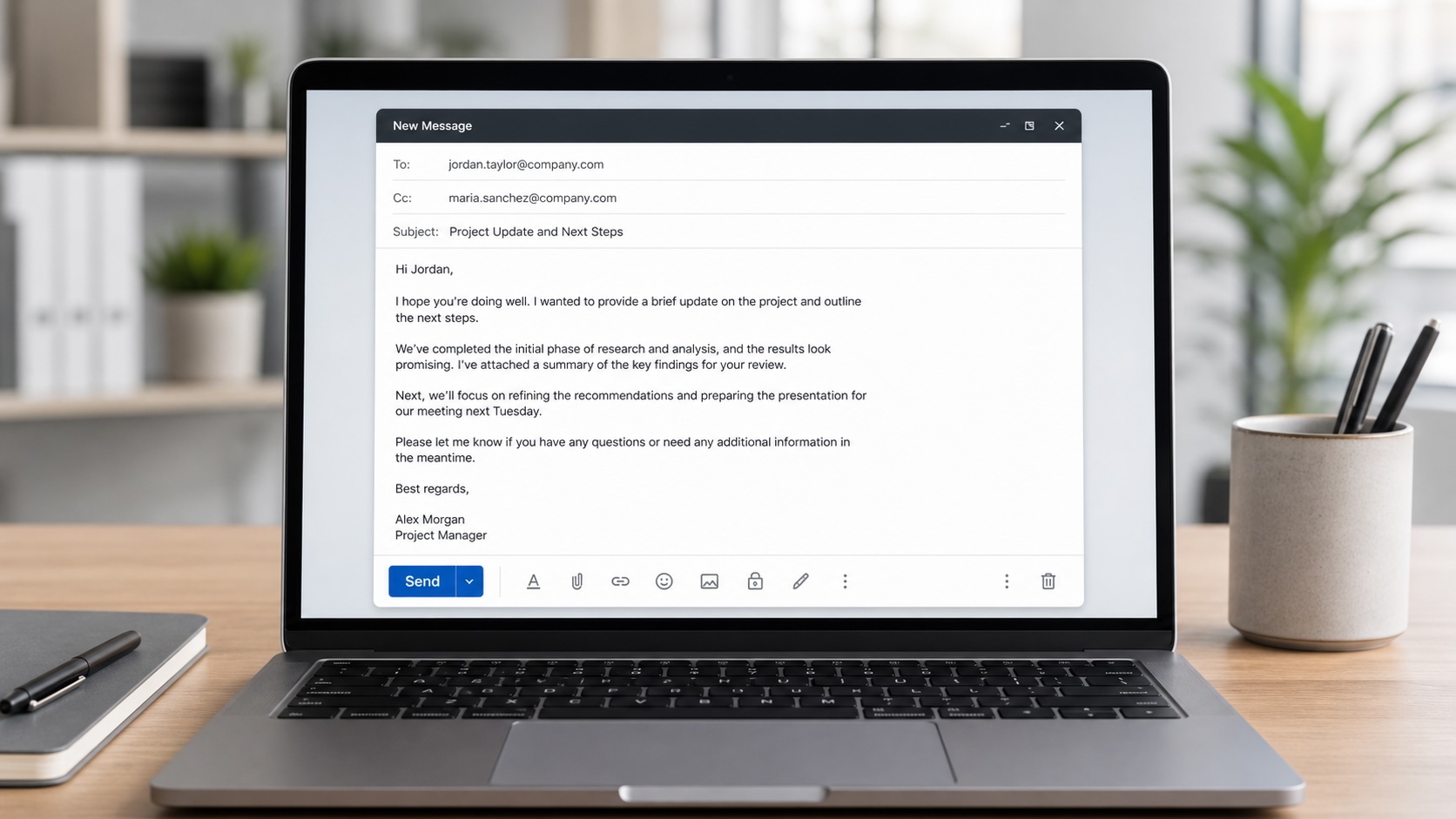
For engineers, researchers, and technical professionals working with Japanese companies, email is more than a way to transfer information. It is also a record of responsibility, schedule, agreement, and professional tone. A good Japanese business email is polite, structured, specific, and easy for the reader to act on.
Quick summary
- Use a clear subject line that shows the topic, request, or deadline.
- Start with a polite greeting, then state the purpose early.
- Separate background, request, deadline, and next action.
- For technical topics, attach or summarize data clearly rather than writing a long, dense email.
- When in doubt, be polite, specific, and easy to respond to.
Why email style matters in Japanese workplaces
In Japanese workplaces, email often plays several roles at once. It communicates information, confirms decisions, creates a written record, and helps coordinate people across teams, departments, companies, and universities.
For technical professionals, this is especially important because projects often involve experiments, specifications, reports, schedules, samples, drawings, quality checks, intellectual property, or customer requirements. A vague email can delay decisions or create misunderstanding.
The goal is not to write beautifully formal Japanese. The goal is to write in a way that is respectful, clear, and useful for the person receiving the email.
Basic structure of a Japanese business email
A standard Japanese business email usually follows a predictable structure. This structure helps the reader understand who is writing, why they are writing, what action is needed, and by when.
| Part | Purpose | Practical advice |
|---|---|---|
| Subject line | Shows the topic and purpose immediately. | Include the project name, document name, meeting date, request, or deadline. |
| Recipient line | Identifies the person or group being addressed. | Use company, department, name, and appropriate honorific if needed. |
| Opening greeting | Sets a polite professional tone. | Use a simple standard phrase rather than an overly casual opening. |
| Purpose | Explains why you are writing. | State the purpose early, preferably within the first few lines. |
| Details | Provides background, data, options, or context. | Use short paragraphs, bullets, or tables for technical information. |
| Request / next action | Makes clear what you want the reader to do. | State the action, deadline, and expected response format. |
| Closing | Ends politely and professionally. | Use a simple closing phrase and your signature. |
Subject lines for technical emails
A weak subject line can make even an important email easy to miss. A good subject line should help the reader understand the topic before opening the message.
Useful subject line patterns
- [Request] Review of test results by May 10
- [Confirmation] Specifications for prototype sample A
- [Meeting] Agenda for May 12 technical discussion
- [Report] Initial evaluation results for sensor module
- [Action required] Approval needed for revised drawing
If you write in Japanese, labels such as 【確認依頼】, 【ご相談】, 【資料送付】, or 【日程調整】 are commonly used. However, avoid overusing urgent labels unless the matter is truly urgent.
Common phrases and what they mean
Japanese business email phrases can sound indirect when translated literally. The table below gives practical meanings rather than word-for-word translation.
| Japanese phrase | Practical meaning | When to use |
|---|---|---|
| お世話になっております。 | A standard professional greeting. | At the beginning of many business emails. |
| ご確認いただけますでしょうか。 | Could you please check this? | When asking someone to review information, documents, or data. |
| ご教示いただけますと幸いです。 | I would appreciate your advice or guidance. | When asking for information or clarification politely. |
| 念のため共有いたします。 | I am sharing this for your reference. | When sending information that may be useful but does not require urgent action. |
| 恐れ入りますが、 | I am sorry to trouble you, but... | Before making a polite request. |
| お手数をおかけしますが、 | I apologize for the inconvenience, but... | When asking someone to do something that takes effort. |
| 何卒よろしくお願いいたします。 | Thank you for your cooperation. | At the end of a polite request or formal email. |
How to write requests clearly
In technical work, politeness is important, but clarity is equally important. If the request is too indirect, the reader may not know whether you are asking for information, approval, a decision, a correction, or only general comments.
A clear request should include the action, reason, deadline, and expected output.
A clear request should answer
- What do you want the reader to do?
- Why is the action needed?
- By when do you need the response?
- Should they reply by email, edit a document, approve a drawing, or join a meeting?
- What happens next after they respond?
Example: Request for technical review
Dear [Name],
I hope you are doing well. I am writing to ask whether you could review the attached initial test results for prototype sample A.
In particular, I would appreciate your comments on the following points:
- Whether the measurement conditions are appropriate
- Whether the observed variation is within an acceptable range
- Whether additional control experiments are needed
If possible, could you please send your comments by Friday, May 10? We plan to discuss the next test conditions in our meeting next week.
Thank you very much for your help.
How to present technical information
Technical professionals often want to include all details in one email. However, long emails can become difficult to read. For complex data, it is usually better to summarize the key message in the email and attach the full document separately.
The body of the email should help the reader understand the main point quickly. The attachment can contain the details.
| Information type | Good email practice | Better placed in attachment? |
|---|---|---|
| Key conclusion | State directly in the email. | No |
| Important numbers | Summarize in a short table or bullet list. | Sometimes |
| Detailed raw data | Mention where it can be found. | Yes |
| Experimental conditions | Summarize only the most relevant conditions. | Yes, if detailed |
| Requests for decision | State clearly in the email. | No |
| Long background explanation | Keep short and link to or attach details. | Often yes |
Follow-up emails
Follow-up emails are common in business. They should be polite, short, and specific. Avoid sounding impatient unless the deadline is urgent and clearly agreed in advance.
Example: Polite follow-up
Dear [Name],
I hope this message finds you well. I am writing to briefly follow up on my previous email regarding the review of the prototype test results.
As we would like to finalize the next test conditions this week, I would be grateful if you could let me know whether you have any comments by Thursday.
Thank you very much for your time.
If the matter is urgent, explain why. A vague statement such as "This is urgent" is less useful than saying, "We need to submit the revised specification to the customer by Friday afternoon."
Apologies and delays
Delays happen in technical projects. When you need to report a delay, be honest and specific. A good delay email should explain the situation, impact, new schedule, and next action.
Example: Reporting a delay
Dear [Name],
I am sorry to inform you that the additional test for sample B will take longer than expected due to instability in the measurement setup.
We are currently checking the alignment and environmental conditions. Based on the current status, we expect to complete the test by May 15 and share the summarized results by May 16.
I apologize for the delay and will update you immediately if the schedule changes.
Meeting follow-ups and minutes
After technical meetings, a short follow-up email can prevent misunderstandings. It does not need to be long. It should summarize decisions, action items, responsible persons, and deadlines.
Useful meeting follow-up structure
- Thank the participants.
- Summarize key decisions.
- List action items with responsible people and deadlines.
- Attach materials if needed.
- Ask participants to correct any misunderstanding.
Example: Meeting summary
Dear all,
Thank you for joining today’s technical discussion. I have summarized the main points below.
- Sample A will be tested under condition 2.
- The evaluation period will be extended by one week.
- [Name] will confirm the revised measurement protocol by May 12.
- [Name] will prepare the updated report template by May 13.
Please let me know if I have misunderstood any point.
Internal and external emails
The tone of an email may differ depending on whether you are writing to a colleague, manager, customer, supplier, university collaborator, or government-related organization. External emails usually require more formal wording and clearer context.
| Recipient | Tone | What to be careful about |
|---|---|---|
| Internal teammate | Polite but relatively direct. | Clarify action items and deadlines. |
| Manager | Concise, structured, and decision-oriented. | State conclusion, risk, and recommendation. |
| Customer | Formal, careful, and externally appropriate. | Avoid unapproved statements, speculation, or confidential information. |
| Supplier | Clear and specific. | Include specifications, quantity, schedule, and required confirmation. |
| University collaborator | Respectful and context-rich. | Clarify publication, data sharing, and meeting expectations when relevant. |
Confidentiality and attachments
Technical emails may include confidential information such as unpublished data, specifications, customer information, drawings, code, samples, or patent-related ideas. Before sending information outside your organization, check the internal rules.
Be especially careful with forwarding emails, attaching documents, using cloud links, sending data to personal email addresses, or discussing unpublished results with external collaborators.
Important note
Email is a written record. Before sending technical information, consider whether the recipient is appropriate, whether the attachment is correct, whether confidential data is included, and whether internal approval is required.
Common mistakes
- Writing a vague subject line: The reader may not understand the priority or topic.
- Putting the request at the end: Busy readers may miss what action is needed.
- Being too indirect: Politeness should not hide the main request or deadline.
- Writing too much technical detail: Summarize the key point and attach the full data if needed.
- Forgetting the deadline: If timing matters, state it clearly.
- Sending confidential information casually: Check internal rules before sharing technical data.
- Not following up after meetings: Decisions and action items may become unclear.
Final checklist before sending
- Does the subject line show the topic and purpose?
- Is the main request clear within the first few lines?
- Did you explain the reason and deadline?
- Are technical details summarized in a readable way?
- Are attachments correct and clearly named?
- Did you check whether confidential information is included?
- Is the tone appropriate for the recipient?
- Would the reader know exactly what to do next?
Important note
Japanese business email practices vary by company, industry, generation, department, and relationship. This article provides general guidance for technical professionals, not fixed rules. When possible, follow your organization’s internal style and ask trusted colleagues how emails are usually written in your team.
Useful sources to check
For practical business email writing, your own organization’s internal templates and senior colleagues are often the most useful sources. For language learning and general business Japanese, you may also check institutional or educational resources.
- Your company's internal email templates and communication guidelines
- Your department's past meeting minutes and project email examples
- University career center resources for business Japanese, if available
- Japanese language textbooks or courses focused on business communication
- Trusted colleagues who regularly communicate with customers, suppliers, or managers
Read next